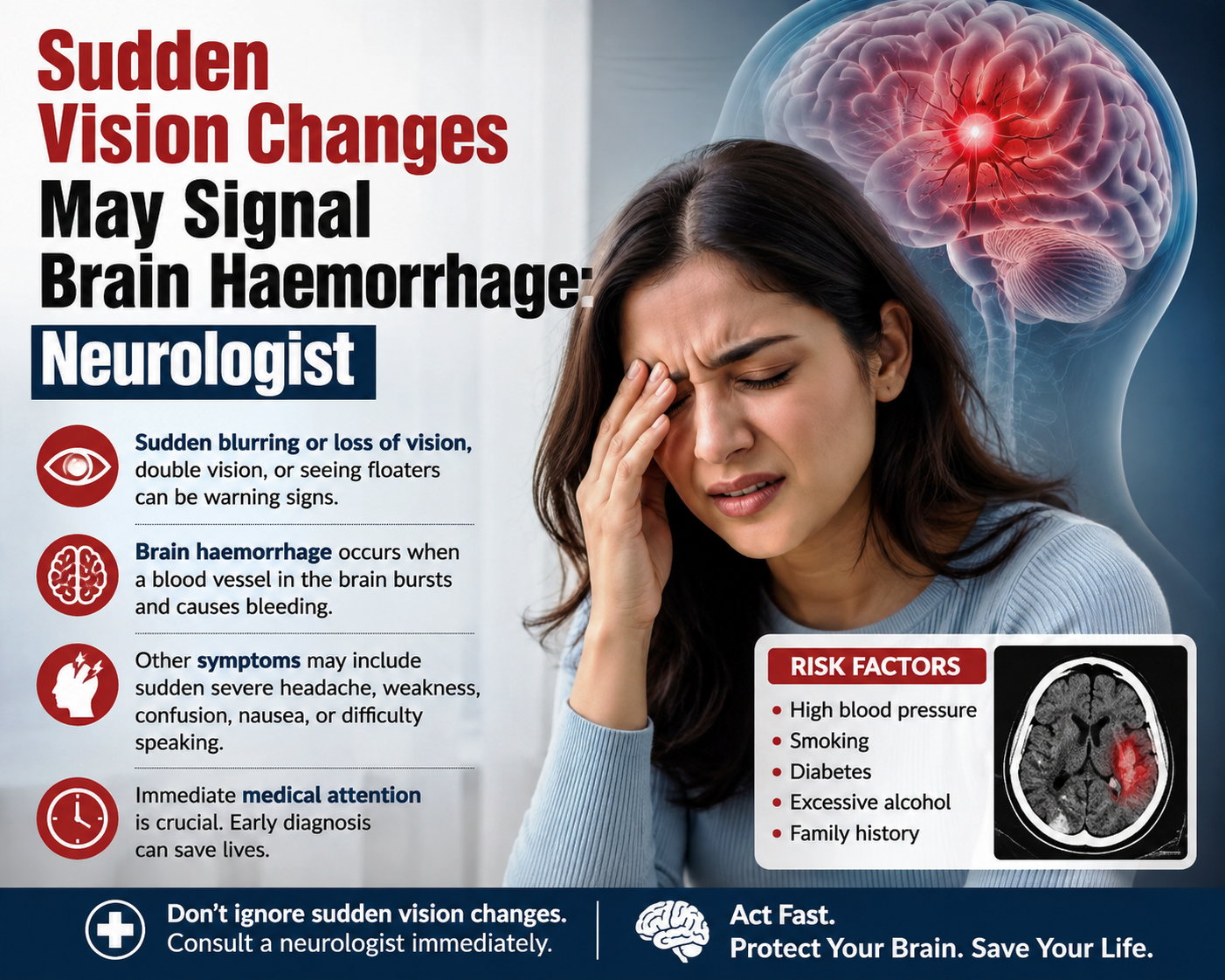
GREATER NOIDA: Sudden changes in vision, severe headache, weakness, speech difficulty, loss of balance or seizures may be warning signs of a brain haemorrhage and should not be ignored, doctors said, citing the case of a 56-year-old man whose abrupt visual disturbance turned out to be a rare haemorrhage in the occipital region of the brain.
The patient was successfully treated at Yatharth Super Speciality Hospital, Omega-1, Greater Noida, where timely imaging, close neurological monitoring and multidisciplinary care helped him recover without requiring surgery.
The case also presented a significant clinical challenge for the treating team as the patient was already suffering from hypertension, chronic kidney disease (CKD) and gastritis, requiring doctors to carefully balance neurological treatment with management of his other conditions.
Dr Saumya H Mittal, Senior Consultant, Neurology, Yatharth Super Speciality Hospital, Omega-1, Greater Noida, said the patient had initially presented to the hospital’s OPD with neurological complaints and was being evaluated. On the sixth day of his hospital stay, he suddenly developed difficulty seeing objects and noticed an enlarged blind spot.
Given the abrupt visual symptoms, doctors advised an immediate non-contrast CT (NCCT) scan of the head. The scan revealed a right occipital lobar haematoma, prompting urgent neurological assessment.
An MRI of the brain with MR angiography subsequently confirmed an acute-to-subacute right occipital lobar haematoma with surrounding perilesional oedema. Importantly, MR angiography did not show any vascular abnormality or malformation that could have been responsible for the bleeding.
With the patient’s clinical condition and imaging findings taken into account, the medical team decided against surgical intervention and opted for conservative neurological management. He was kept under close observation and treated with anti-oedema therapy and supportive care.
The patient’s existing medical conditions added another layer of complexity. His blood pressure was gradually optimised, while the nephrology team simultaneously assessed his CKD. A kidney biopsy that was being considered was deferred because the recent intracerebral haemorrhage increased the risk of bleeding.
His gastritis was also evaluated and he was diagnosed with Helicobacter pylori infection, for which appropriate treatment was started.
Throughout his hospital stay, the patient remained under continuous observation. He responded to the medical and supportive treatment, with his neurological status gradually improving. He was eventually discharged in a haemodynamically and neurologically stable condition on oral medication and with follow-up advice.
Dr Mittal said, “Brain haemorrhage can present with common symptoms such as sudden visual disturbances, severe headache, weakness, speech difficulty or loss of balance, which should never be ignored. Sudden onset of symptoms such as loss of vision, loss of sensation or seizures should also be considered possible warning signs requiring immediate medical attention.
“Early neuroimaging and prompt neurological assessment are crucial for accurate diagnosis and timely treatment. Not every brain haemorrhage requires surgery; carefully selected patients can be managed successfully with conservative treatment, provided they are closely monitored by an experienced multidisciplinary team.”
The location of the haemorrhage was significant in this case. The occipital lobe, situated at the back of the brain, plays a key role in processing visual information. Bleeding in this area can therefore affect a person’s visual field and ability to see normally.
As a result, the patient’s sudden visual disturbance became the crucial clinical clue that led doctors to investigate the possibility of a neurological emergency rather than treating it as an isolated eye problem.
The extensive evaluation included NCCT of the head, MRI brain stroke protocol with MR angiography, MRI of both orbits, 2D echocardiography, CT renal arteries and laboratory investigations. The investigations helped doctors assess the brain haemorrhage while also evaluating possible contributing factors and the patient’s associated medical conditions.
Doctors said the case underlined the importance of recognising neurological symptoms early, particularly when they appear suddenly. While facial drooping or weakness of an arm or leg are commonly associated with stroke, neurological emergencies can present differently depending on the part of the brain affected.
They also stressed the importance of controlling risk factors. People with hypertension, diabetes, kidney disease and other chronic conditions should undergo regular health checks and adhere to prescribed treatment. Uncontrolled hypertension remains a major risk factor for intracerebral haemorrhage.
The case also highlights that a diagnosis of brain haemorrhage does not automatically mean surgery. Treatment decisions depend on factors including the location and size of the bleed, neurological status, brain swelling, associated complications and the patient’s overall condition.
In selected patients, Dr Mittal said, conservative treatment involving close neurological monitoring, control of blood pressure, management of brain swelling and treatment of underlying risk factors can be an appropriate approach.
The hospital’s neurology team said early recognition and immediate medical attention remain crucial in reducing the risk of complications and long-term disability.