NEW DELHI: The floodwaters may eventually recede, roads may be rebuilt and schools may reopen. But for thousands of children and families who watched their homes, communities and loved ones being swept away in Nepal, the disaster may not end when the water does.
Authorities and relief agencies now need to brace for another, less visible emergency — the psychological aftermath of the flash floods.
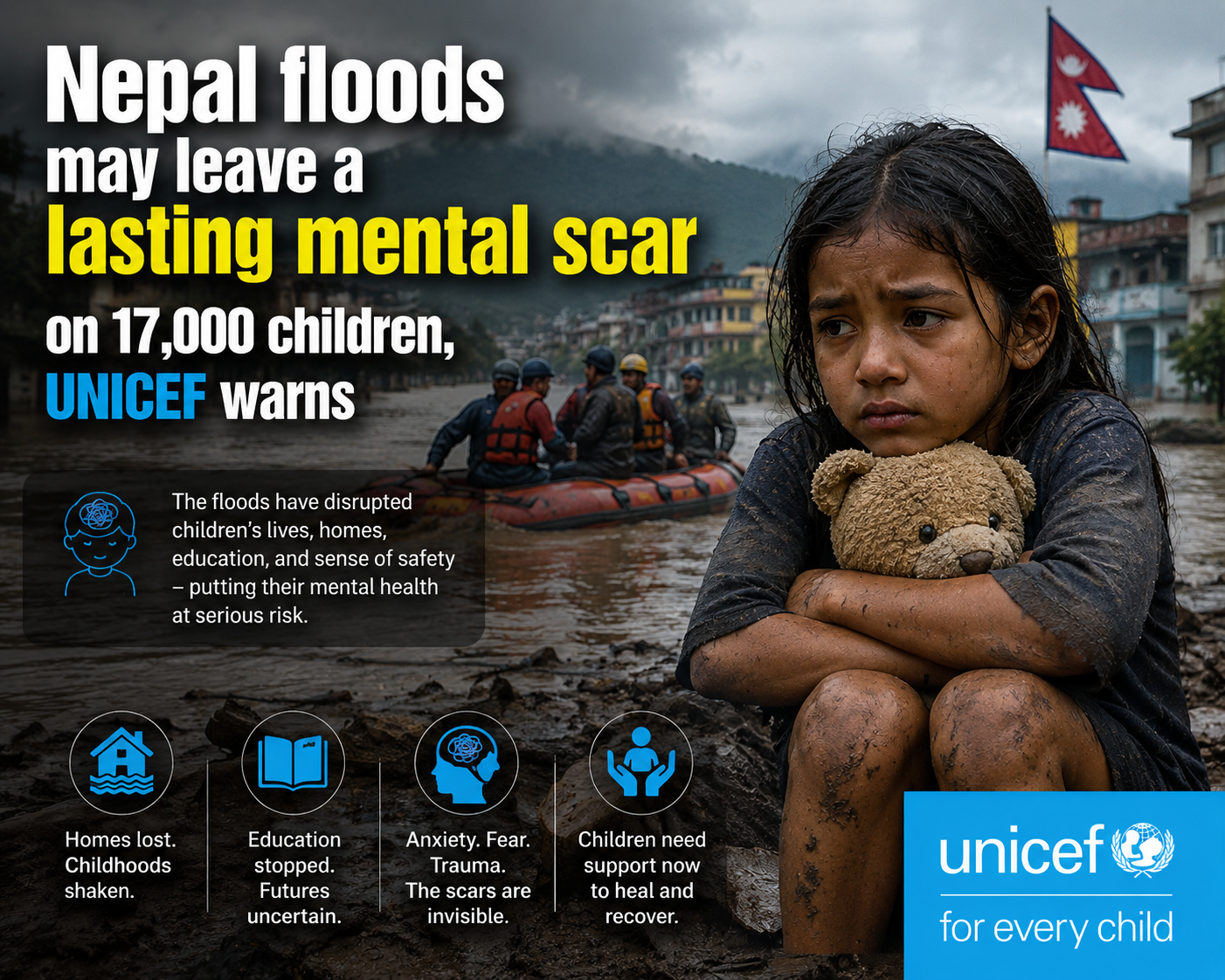
The devastation that struck Nepal’s Rasuwa, Nuwakot and Dhading districts on August 26 has already affected at least 17,000 children, according to UNICEF. An estimated 332 people had died by August 27, including at least 14 children, while hundreds remained missing. Eighteen schools were completely destroyed and another 20 damaged, leaving around 10,000 school-age children in need of urgent educational support.
But behind these numbers are children who may have seen their parents disappear, parents who may have lost children, families separated in the chaos and survivors who may have spent hours fearing for their lives.
For them, the next battle may not be against floodwater but against memories.
UNICEF has already mobilised mental health and psychosocial support teams and is working to identify and reunite children separated from their families. That is an important first response, but the psychological needs of survivors are likely to extend well beyond the immediate relief phase.
The experience of past disasters offers a warning.
A 2025 study of 197 survivors of the 2004 Aceh tsunami, conducted two decades after the disaster, found that 78.17% had low mental health or psychological wellbeing. The researchers concluded that the psychological impact of the catastrophe could persist long after the physical destruction had disappeared.
Another long-term study of trauma survivors found that nearly half reported at least one lasting psychiatric symptom even more than 20 years after the original trauma, although only a small proportion met the criteria for full-blown PTSD.
For a child who saw a wall of water carry away a parent, normality may not return simply because the electricity comes back.
Children are particularly vulnerable after a disaster because their sense of security is closely tied to parents, care givers, schools and familiar surroundings.
When all four are disrupted simultaneously, the emotional impact can be profound.
A child may become unusually quiet, cling to a parent, refuse to sleep alone, develop nightmares, become frightened by rain or rushing water or repeatedly replay what happened. Others may become irritable, aggressive or withdrawn. Some may struggle to concentrate or return to school.
Such reactions do not automatically mean that a child has developed PTSD. Many people experience acute distress after a catastrophe and gradually recover as safety, family support and routine return.
The concern arises when symptoms persist, intensify or begin interfering with everyday life.
That is why mental health support cannot be treated as an optional addition to disaster relief. It has to become part of the recovery architecture from the beginning.
And Nepal’s scale of destruction makes that particularly urgent.
A UNICEF account of the floods describes 13-year-old Sonika Nagarkoti running uphill with her three-year-old brother as the flood swept away the family home. Her family is now sheltering in a school, with little more than the clothes they managed to carry.
For such children, psychological recovery is closely linked to physical recovery.
Finding missing relatives matters. Reuniting separated children with caregivers matters. Providing safe shelter matters. Restoring schools matters. Creating spaces where children can play, interact and resume routines matters.
These are not merely humanitarian tasks. They are also mental-health interventions.
Parents, too, may be carrying invisible wounds
The psychological toll will not be confined to children.
Parents who lost children, adults searching for missing family members, teachers who witnessed students in danger and rescuers exposed to death and destruction may all face prolonged psychological distress.
For parents who have lost loved ones, grief can become complicated by uncertainty when bodies have not been recovered or families remain separated.
There is also the burden of rebuilding livelihoods.
A person who has lost a home, income, livestock or a business is not simply dealing with memories of the disaster. They are waking up every day to its consequences.
This prolonged uncertainty can keep the stress response activated long after the immediate emergency has passed.
Research following the 2004 Indian Ocean tsunami has shown just how enduring such effects can be. Longitudinal work among survivors in Indonesia found persistent post-traumatic stress symptoms years after the disaster, with researchers also identifying long-term changes in biological markers associated with chronic stress.
A separate qualitative study of South Andaman survivors, published recently, also reported continuing anxiety, intrusive memories and sleep difficulties two decades after the 2004 tsunami.
Recovery must begin before the headlines fade
The danger is that mental health receives attention during the first few days of a disaster and then disappears from the response once the search-and-rescue operation ends.
That would be a mistake.
The psychological impact of disasters can emerge in stages. Some survivors may initially remain focused entirely on survival, finding food, shelter and missing relatives. Distress may surface only weeks or months later, when the immediate crisis has passed.
For children, returning to school can therefore become an important part of healing. UNICEF has already identified temporary learning centres, replacement educational material and psychosocial support as priorities for affected children and teachers.
But schools must be more than temporary classrooms. They can become safe spaces where children regain routine, reconnect with peers and begin processing what they have experienced.
Community-based mental health services will also be crucial, particularly because specialist psychiatric care may not be readily available in disaster-hit remote areas.
Frontline health workers, teachers and community volunteers can be trained to identify warning signs and refer children and adults who require professional intervention.
Tele-mental health services could provide another layer of support where physical access remains difficult.
The second emergency must not become invisible
Nepal’s immediate priorities are understandably food, water, shelter, medical care, rescue and family reunification. But mental health must be built into every stage of the response — from emergency shelters to schools and primary healthcare centres.
The flood has already destroyed physical infrastructure. It should not be allowed to leave an equally deep but invisible scar on an entire generation.
Authorities therefore need to plan not just for the first 72 hours, but for the months and years that follow.
Counselling, psychological first aid, school-based support, grief services and referral pathways for severe mental-health conditions should continue long after relief camps disappear from the news cycle.
The next phase of Nepal’s recovery must ensure that survivors are not left alone to fight that storm.
ENDS