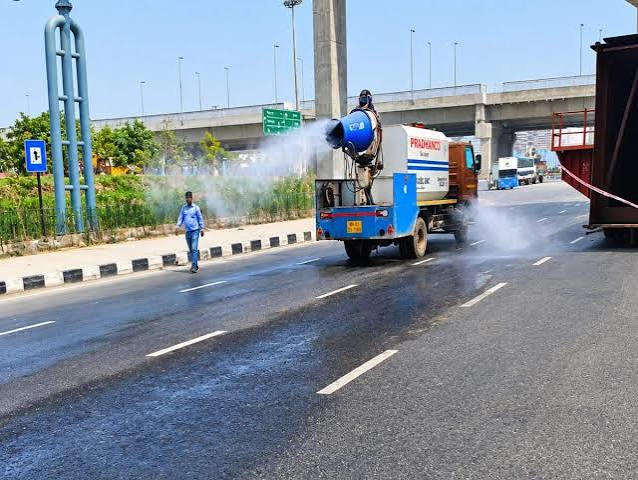
NEW DELHI: With air pollution a major concern in Delhi-NCR ahead of winter, the National Highways Authority of India (NHAI) has stepped up dust-control measures on national highways and expressways. It has deployed nearly 60 water sprinklers and tankers, 14 anti-smog guns, 23 mechanical road-sweeping machines and more than 900 workers.
The measures are aimed at reducing road dust, a contributor to pollution in the region, as winter approaches and stagnant weather conditions can make it harder for pollutants to disperse, said an official from the NHAI.
The NHAI has also intensified mechanical sweeping and water sprinkling across highway stretches, while pushing ahead with projects intended to ease traffic congestion and reduce vehicular emissions.
Of the sweeping machines deployed, 13 are operating along 157 km of national highways within Delhi-NCR, according to the authority.
Alok Deepankar, Member (Technical), NHAI, reviewed the pollution-control measures and directed field teams to ensure that equipment and manpower are fully deployed, said the official.
Deepankar also called for regular operation of anti-smog guns, daily mechanical sweeping and strict compliance with the norms prescribed by the Commission for Air Quality Management (CAQM).
These include covering construction materials to prevent dust from escaping, maintaining dust-free road surfaces and intensifying pollution-control measures in accordance with the applicable Graded Response Action Plan (GRAP) stages.
NHAI officials have been asked to monitor the work daily and submit progress reports supported by geo-tagged photographs.
Road dust and dust from construction activity are among the sources of particulate pollution in Delhi-NCR. Mechanical sweeping, water sprinkling and covering loose construction materials can help reduce dust being stirred up and carried into the air.
However, these measures need regular implementation and cannot, by themselves, address the region’s wider air pollution problem, which also involves vehicle emissions, industrial sources, waste burning and other contributors.
NHAI’s latest measures come ahead of the period when deteriorating air quality becomes a recurring concern across the capital and neighbouring areas.
The effectiveness of the effort will depend on whether the measures are sustained on the ground and whether dust is controlled at source, rather than merely shifted from one stretch of road to another.
The review also covered major road projects intended to improve traffic flow, including the Urban Extension Road-II (UER-II), Dwarka Expressway, DND-Sohna Expressway and Delhi-Dehradun Expressway.
Reducing traffic congestion can help limit emissions associated with vehicles idling in slow-moving traffic. However, the extent of any air-quality benefit will depend on traffic patterns, vehicle numbers and how the roads are used after opening.
NHAI has also stressed the need to speed up proposed decongestion projects and respond promptly to public complaints received through the Green Delhi app and social media platforms.
As part of its environmental initiatives, NHAI said it planted around 9.80 lakh saplings in the National Capital Region during 2025-26, exceeding its target of 9.52 lakh. The authority reported survival rates of more than 90%.
It also said around 13.58 lakh tonnes of inert material recovered from Delhi’s landfill sites had been used in embankment construction for the UER-II and DND-Sohna corridors. The initiative supports the reuse of suitable waste material in infrastructure projects.
While plantation and waste reuse can contribute to broader environmental objectives, their benefits should be assessed alongside the more immediate task of controlling dust and emissions from roads and construction sites.