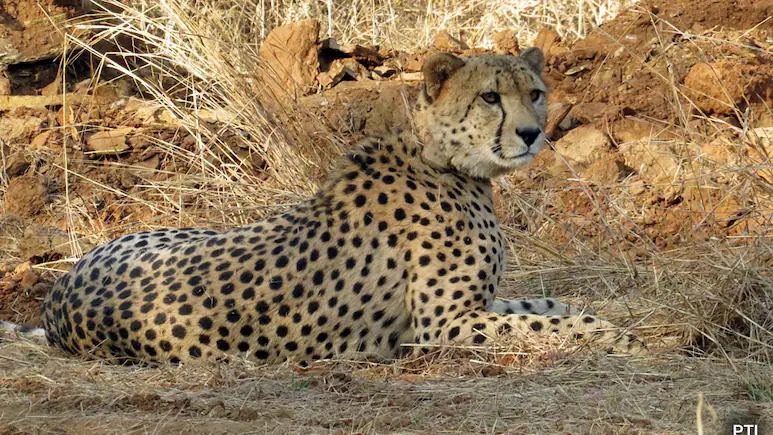
NEW DELHI: A 19-month-old cheetah brought into the world under India’s ambitious cheetah reintroduction programme has died after being hit by firearm pellets in Madhya Pradesh, prompting the Centre to order a high-level investigation into the incident and the security arrangements meant to protect the animals.
The male cheetah, identified as KNG22, was an offspring of Nirva, a female cheetah brought to India from South Africa. He was found injured on October 25 in the territorial forests of Morena district, outside the protected area of Kuno National Park. Despite emergency surgery and intensive veterinary care, he died on October 27.
Five firearm pellets were removed from his body during surgery at a veterinary facility in Jabalpur. Medical examinations found multiple internal injuries linked to the pellets.
Taking serious note of the death, the Union Environment Ministry on Wednesday deputed a three-member central team to investigate the circumstances and examine whether existing protection measures were adequate. The team includes the Inspector General of Forests from the National Tiger Conservation Authority (NTCA), the Additional Director of the Wildlife Crime Control Bureau (WCCB) and the WCCB’s Regional Deputy Director.
The team will examine the available evidence and work with the Madhya Pradesh Forest Department. It will also review security protocols, monitoring systems and other measures used to protect the reintroduced cheetah population. Its findings and recommendations will be submitted to the ministry for further action.
The Madhya Pradesh government has already constituted a Special Task Force comprising forest and police officers to investigate the incident. The central team will coordinate with the state authorities.
The investigation is expected to establish how the cheetah sustained the injuries and whether anyone was responsible. The Centre has not yet identified a suspect or announced a conclusion about the circumstances of the shooting.
The death has raised concerns about the safety of cheetahs that move beyond the boundaries of protected areas. While Kuno remains the principal site for the reintroduction programme, the animals’ movement through surrounding forests makes protection and monitoring beyond the park important as well.
Project Cheetah was launched on September 17, 2022, to bring the species back to India after it was declared extinct in the country in 1952. Eight cheetahs arrived from Namibia in September 2022, followed by 12 from South Africa in February 2023. A further group arrived from Botswana in February 2026, as India continued efforts to establish a viable population.
The programme is significant because it marks an attempt to restore a species that disappeared from the country after decades of hunting and other pressures. Its success depends not only on the animals surviving and breeding, but also on their ability to live in suitable habitats with sufficient prey and effective protection.
Cheetah deaths have been recorded during the programme, including deaths of adults and cubs in earlier years. However, the circumstances of each death differ. The current case stands apart because medical examinations confirmed firearm pellet injuries, making the investigation into possible human involvement particularly important.
The injured cheetah was found in the Sheopur Territorial Forest Division, according to the ministry’s statement. He was rescued on October 25 and given emergency treatment before being shifted to Jabalpur for specialised care.
The death of a young, India-born cheetah is a reminder that reintroducing a species is only the first step. Ensuring its long-term survival requires sustained monitoring, secure habitats and effective protection wherever the animals roam.