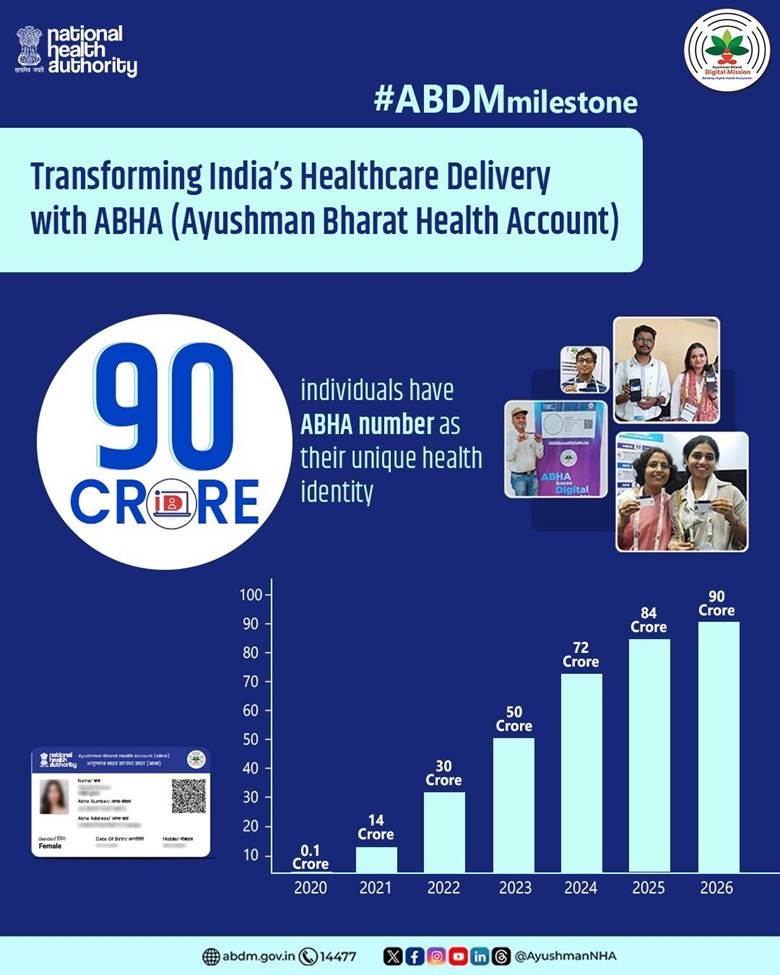
NEW DELHI: India’s ambitious effort to create a unified digital health infrastructure has crossed a major milestone, with more than 90 crore Ayushman Bharat Health Accounts (ABHAs) now created under the Ayushman Bharat Digital Mission (ABDM), reflecting the growing adoption of digital health services across the country.
The achievement marks a significant step towards building an interconnected, citizen-centric healthcare ecosystem where individuals can securely access, store and share their health records across hospitals, clinics, laboratories and digital health platforms.
Implemented by the National Health Authority (NHA) under the Ministry of Health and Family Welfare, the Ayushman Bharat Digital Mission seeks to create the digital backbone of India’s healthcare system by enabling seamless exchange of health information with patient consent.
At the heart of the initiative is the ABHA number, a unique 14-digit digital health identity that allows citizens to link their medical records generated at different healthcare facilities and access them through a single platform. The system is designed to reduce dependence on physical documents while ensuring continuity of care across healthcare providers.
The growth of the programme has been steady since its launch. The number of ABHAs increased from 14.7 crore in 2021 to 30.4 crore in 2022, 50.6 crore in 2023, 72.2 crore in 2024 and 84.5 crore in 2025, before crossing the 90-crore mark this year, said a government statement here.
Health officials say the rapid expansion reflects increasing trust in digital health services and growing participation by States, Union Territories, healthcare institutions and technology partners.
“The creation of over 90 crore ABHAs reflects the growing participation of citizens, States, UTs and ecosystem partners in the Ayushman Bharat Digital Mission,” said Dr. Sunil Kumar Barnwal, Chief Executive Officer, National Health Authority.
“ABHA is an important step towards empowering citizens with secure, consent-based access to their own health information. As ABDM adoption deepens, ABHA will enable continuity of care, reduce dependence on physical records and support a more seamless, transparent and citizen-centric healthcare delivery system,” he said.
Among the States, Uttar Pradesh has emerged as the largest contributor, accounting for more than 15.3 crore ABHAs. Rajasthan and Maharashtra have each crossed the seven-crore mark, followed by Bihar with 6.3 crore and West Bengal with 5.9 crore accounts, as per the statement.
Several smaller States and Union Territories have achieved near-universal coverage. The Andaman and Nicobar Islands, Ladakh, Lakshadweep, and Dadra and Nagar Haveli and Daman and Diu have recorded full saturation. Among larger States, Andhra Pradesh has achieved nearly 99% saturation, followed by Odisha, Rajasthan, Himachal Pradesh and Chhattisgarh, it added.
The data also point to growing participation by women in the digital health ecosystem. Nearly half of all ABHA holders — 49.75% — are women, a development that officials say could strengthen access to maternal and child healthcare services, immunisation programmes and other essential health interventions.
The government believes that digital health records can help improve efficiency and transparency in healthcare delivery by reducing duplication of tests, facilitating faster access to medical histories and enabling informed clinical decision-making.
The broader Ayushman Bharat Digital Mission is built around several digital public infrastructure components, including the Healthcare Professionals Registry, Health Facility Registry, Health Information Exchange and Consent Manager, Unified Health Interface and National Health Claims Exchange. Together, these platforms are intended to create an interoperable framework through which health information can move securely between different stakeholders.
For more details, contact indiahealthbuddy@gmail.com