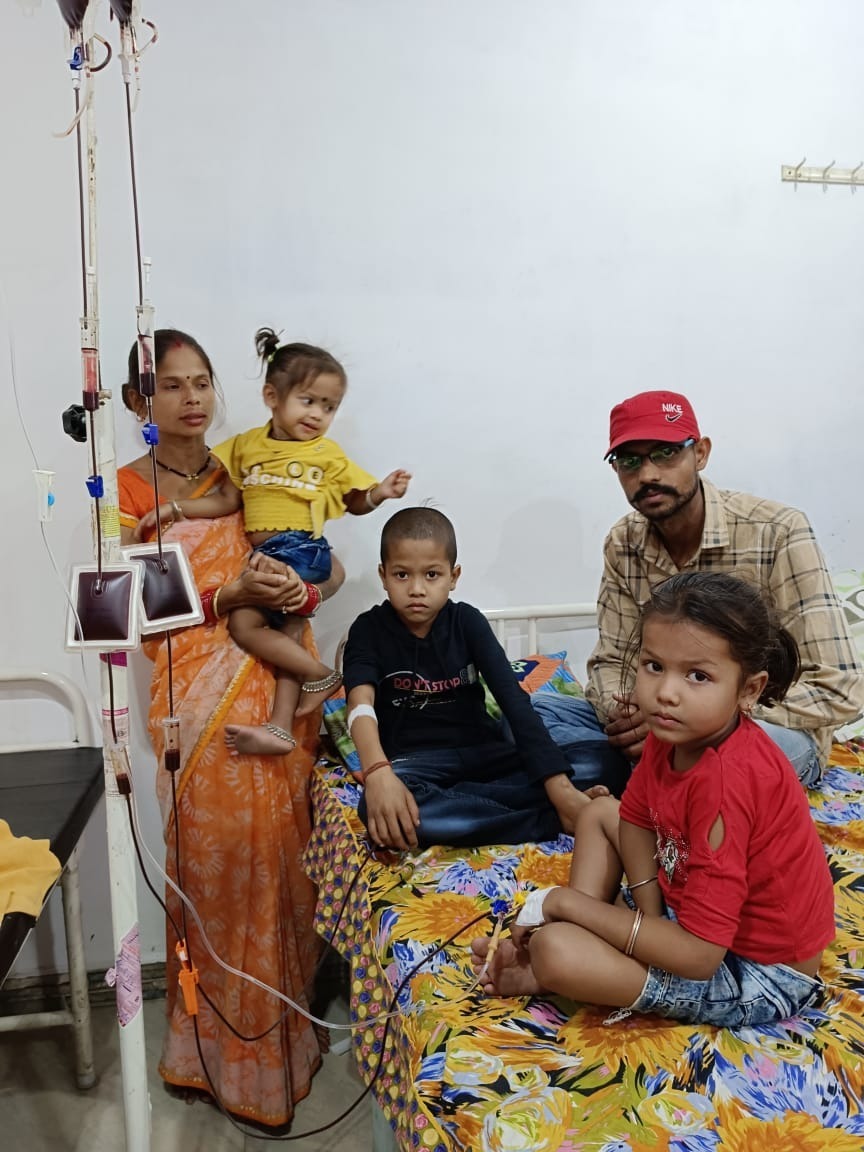
NEW DELHI: She was only two years old and far too young to understand what it meant to become a donor. Yet, for her elder brother battling thalassemia, little Khushi Yadav became the person who could give him what years of treatment had failed to provide — a chance at a life beyond regular blood transfusions.
As Raksha Bandhan celebrates the bond between brothers and sisters, the story of Som and Khushi Yadav offers a poignant reminder that protection can sometimes come in the form of a medical gift.
Som was just five months old when he was diagnosed with thalassemia major, an inherited blood disorder in which the body fails to produce enough healthy haemoglobin to carry oxygen. His younger sister Saumya was later diagnosed with the same condition. Both children became dependent on regular blood transfusions, placing a heavy medical and financial burden on their family living in a small village.
The search for a suitable stem-cell donor became crucial. Neither child had a full human leukocyte antigen (HLA) match within the family, making transplantation difficult.
Then came Khushi.
Born in 2021, the third sibling brought an unexpected possibility. At an HLA-typing camp organised by Narayana Health and KASH Foundation, the family received free HLA testing through DKMS Foundation India.
The result brought hope. Khushi was found to be a perfect 12/12 HLA match for Som.
In 2023, when she was just two years old, Khushi became her brother’s blood stem-cell donor. Today, Som is healthy, goes to school and is able to lead a normal life.
For a family that had spent years struggling with the demands of thalassemia, the transformation has been profound.
When stem cells can offer a way out of lifelong transfusions Thalassemia major can require patients to undergo repeated blood transfusions, sometimes throughout their lives. While transfusions are essential for managing severe disease, they do not eliminate the underlying genetic defect.
For eligible patients, a blood stem-cell transplant, also known as a haematopoietic stem-cell transplant, can potentially offer a cure. The treatment replaces the patient’s diseased blood-forming system with healthy blood stem cells from a suitably matched donor.
But finding that donor is often the biggest hurdle.
HLA matching is central to this process. The closer the match between donor and recipient, the better the chances of a successful transplant and the lower the risk of serious complications such as graft-versus-host disease.
For patients without a suitable family donor, an unrelated donor registry can become an important source of hope. However, finding an unrelated match can be particularly difficult because of India’s vast genetic diversity.
Patrick Paul, Executive Chairman, DKMS Foundation India, said the story of Som and Khushi also highlights the wider challenge faced by patients with blood disorders.
“Not every patient with a blood disorder is fortunate enough to find a matching donor within their family,” he said, pointing out that only 0.09% of Indians in the relevant age group are registered as blood stem-cell donors.
“At DKMS, we work to bridge this gap by helping economically disadvantaged patients access high-resolution HLA typing and, when a family match is not available, connect with the global registry of unrelated donors,” he said.