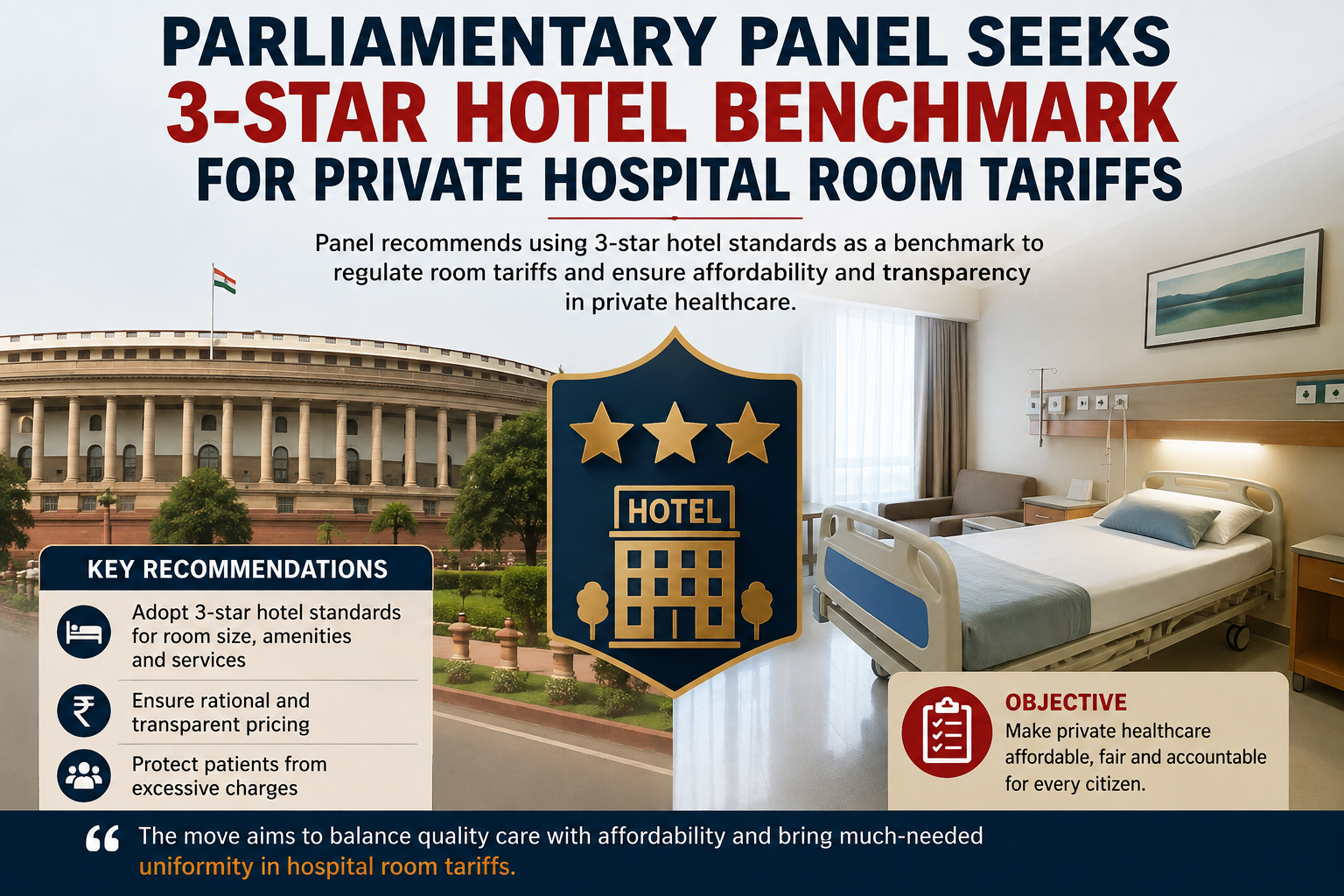
NEW DELHI: Amid the mushrooming of luxurious, five-star-style hospitals across the country, a parliamentary panel has sought a cap on what private hospitals can charge for basic rooms. It has been recommended that in large metropolitan cities the tariff should not exceed the average rate of a nearby three-star hotel.
The recommendation, contained in the Parliamentary Standing Committee on Health and Family Welfare’s 176th report, Affordability and Accessibility of Healthcare Facilities in Public and Private Sectors, has brought the issue of hospital room charges into sharper focus at a time when rising medical expenses are increasingly pushing families into financial distress.
The committee’s proposal is aimed at creating an external benchmark for one of the most visible components of a hospital bill—room rent. It has also called for greater transparency in private healthcare pricing and mechanisms to regulate charges for essential procedures and diagnostic services.
The recommendation comes against the backdrop of a related case before the Supreme Court on regulation of charges levied by private hospitals.
The case arose from a 2020 public interest litigation filed by the Veterans Forum for Transparency in Public Life, which sought regulation of fees charged by private hospitals under the Clinical Establishments framework.
The Supreme Court had earlier directed the union health secretary to consult the states and return with a concrete proposal on hospital rates. The Union Health Ministry subsequently maintained that health is a state subject and that states would have to take the lead in fixing charges. More recently, the Centre has indicated that a balance needs to be maintained—charges should remain affordable for patients while allowing hospitals to remain financially viable.
The parliamentary committee’s recommendation is narrower but potentially significant: in large metropolitan cities, the basic room tariff should not be higher than the average tariff of a nearby three-star hotel.
The comparison is intended as a pricing benchmark rather than an assertion that hospital rooms and hotel rooms offer equivalent services.
A hospital room, unlike a hotel room, is part of a clinical environment and comes with nursing care, patient monitoring, infection-control protocols, emergency support, biomedical infrastructure, and access to doctors and other healthcare professionals.
Yet the panel’s argument is that basic accommodation within a hospital should not itself become an excessive financial burden, particularly for patients who require prolonged hospitalisation.
The proposal could, however, face questions over how such a benchmark would work across cities and hospitals with widely differing costs.
Private hospitals have maintained that room tariffs are linked to the facilities, amenities, and services provided and that they should retain flexibility to price different categories accordingly.
Commenting on the committee’s recommendation, Dr Alexandar Thomas, senior member and adviser, Association of Healthcare Providers of India (AHPI), said, “In my view, private-room rates should continue to be decided by hospitals based on what they offer, while patients always have the option of choosing between these costlier or regular rooms, which are affordable in all hospitals.”
He added that AHPI, a major network representing private hospitals, could examine the recommendations in detail and make a submission to the committee or the government.
The debate over room tariffs is part of a much wider concern over the affordability and transparency of private healthcare.
For many families, the final hospital bill is determined not by a single large charge but by the cumulative effect of room rent, doctor fees, investigations, medicines, consumables, procedures, and other services. When hospitalization stretches over several days, the room component alone can become substantial.
The parliamentary panel has therefore called for greater transparency in the way hospitals communicate charges to patients.
One of its recommendations is that tertiary-care hospitals should provide patients with a comprehensive estimate of the expected cost of treatment before major procedures.
Such an estimate, if implemented effectively, could help families understand their likely financial liability before treatment begins and reduce disputes over unexpected or substantially higher bills.
The committee has also flagged concerns around charges for essential procedures and diagnostic services, seeking stronger mechanisms to regulate them.
Another area that has attracted attention is differential pricing for insured and uninsured patients. The panel has recommended greater scrutiny of such practices and suggested that the Insurance Regulatory and Development Authority of India (IRDAI) examine the issue.
The committee has also looked beyond the question of tariffs to the larger role of private healthcare providers in improving access.
One proposal is to create a mechanism under which a portion of the revenue generated from premium-paying patients could support treatment for economically weaker sections.