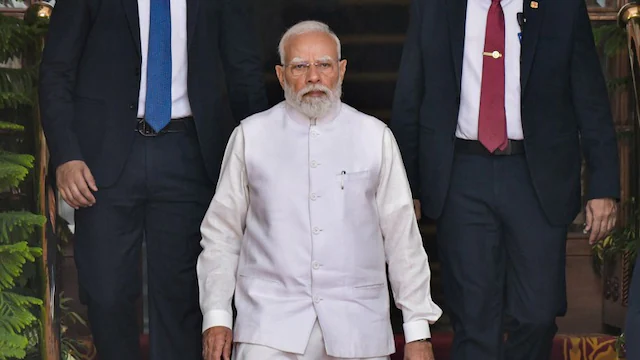
DAMAN: Prime Minister Narendra Modi on Friday said that the Ayushman Bharat health insurance programme has fundamentally transformed access to healthcare in India, extending financial protection to millions of families and significantly reducing out-of-pocket medical expenditure among the poor and middle class.
Addressing a public gathering in Daman after inaugurating and laying the foundation stone for development projects worth ₹2,970 crore, Modi said healthcare remains one of the central pillars of the Union government’s development agenda.
“The first benchmark of development for our government is the improvement in the lives of the poor, the deprived, tribal communities and the middle class,” the Prime Minister said, highlighting the expansion of healthcare services and social protection measures over the past decade.
Referring to the Ayushman Bharat-Pradhan Mantri Jan Arogya Yojana (AB-PMJAY), Modi said the scheme has brought quality healthcare within reach of economically vulnerable sections by providing health insurance coverage of up to ₹5 lakh per family for secondary and tertiary care hospitalisation.
“Today, even the poorest citizen carries an Ayushman Card and has the assurance of free treatment worth up to ₹5 lakh,” he said.
The Prime Minister said the health insurance programme has been complemented by a broader healthcare ecosystem that includes Ayushman Arogya Mandirs, Jan Aushadhi Kendras and digital health initiatives aimed at making healthcare more affordable, accessible and patient-centric.
According to Modi, the combined impact of Ayushman Bharat and the Pradhan Mantri Bhartiya Janaushadhi Pariyojana has resulted in substantial savings for citizens. “Ayushman Cards and Jan Aushadhi Kendras together have helped poor and middle-class families save nearly ₹2.25 lakh crore in healthcare expenditure,” he said.
The Jan Aushadhi network, which provides quality generic medicines at lower prices, has emerged as a key component of the government’s strategy to reduce household spending on medicines, which constitutes a significant portion of healthcare costs in India.
Highlighting progress in public health indicators, the Prime Minister said institutional deliveries have risen sharply in recent years, with more than 90% of births now taking place in healthcare facilities. He also noted substantial improvements in immunisation coverage.
“Before 2014, child immunisation coverage was around 60%. Today, it has reached nearly 90%,” he said, attributing the gains to focused public health interventions and expanded healthcare outreach.
Modi also underscored the expansion of health insurance coverage in the country. He pointed out that before 2014, fewer than 30% of Indian families were covered under any form of health insurance. The launch of Ayushman Bharat, he said, has dramatically altered this landscape by extending financial protection to a much larger section of the population.
The Prime Minister further highlighted the strengthening of healthcare infrastructure in the Union Territory of Dadra and Nagar Haveli and Daman and Diu. He said the establishment of a medical college, the introduction of postgraduate medical courses and the development of NAMO hospitals in Silvassa and Daman have improved access to specialised healthcare services in the region.
“These initiatives are helping create a stronger healthcare system and ensuring that people receive quality medical care closer to their homes,” he said.
Modi also emphasised the benefits of healthcare reforms for women, citing improvements in maternal health services, institutional deliveries and financial protection during medical emergencies. He said women have emerged as among the biggest beneficiaries of expanded healthcare coverage and public health programmes.
For more query, kindly contact indiahealthbuddy@gmail.com