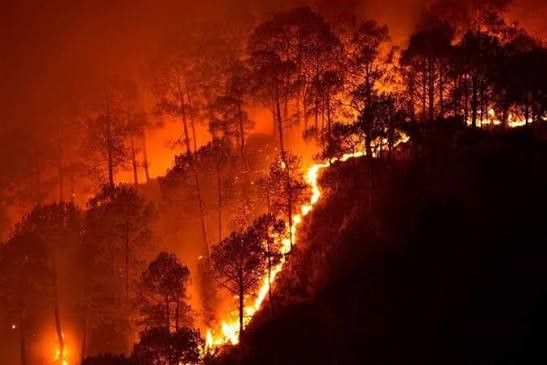
NEW DELHI: Wildfires are no longer just a seasonal forest-management problem. Rising temperatures, prolonged dry spells and increasingly erratic weather are creating conditions for more frequent and intense fire episodes, with consequences extending from forests and farms to air quality, public health and food security.
An editorial published in Current Science has warned that India needs to move beyond conventional firefighting and prepare proactively for what could become longer and more destructive fire seasons.
Writing in the August 10, 2026 issue of Current Science, S K Satheesh, senior scientist from the Center for Atmospheric and Oceanic Sciences and Divecha Center for Climate Change, Indian Institute of Science (IISc), Bengaluru, said extreme fire episodes require a shift from reactive firefighting to landscape management and advanced early-warning systems.
“Adapting to extreme fire seasons requires shifting from responsive conventional firefighting methods to proactive approaches, including landscape management and advanced early warning systems,” Satheesh stated in the editorial.
The warning comes as India’s fire season itself appears to be changing. Traditionally, the country’s forest-fire season extends roughly from November-December to May-June. But rising temperatures, more frequent heatwaves, prolonged dry periods and erratic monsoons are increasingly creating combustible conditions beyond the traditional window.
According to the editorial, fire alerts in the early months of 2026 were more than 80% above the average of the previous decade, underscoring how wildfire risk is becoming a growing environmental concern.
The problem is not confined to forests. Wildfires can degrade air quality, trigger respiratory illnesses, damage biodiversity and vegetation, and release large quantities of carbon dioxide. Repeated burning can also affect soil health, adding another pressure on agriculture and food security.
Satheesh points to a phenomenon known as hydro-climate whiplash. It refers to rapid shifts between wet and dry conditions, and it is a factor that can intensify the risk.
Heavy rainfall can promote rapid growth of vegetation and bushes. When followed by prolonged dry weather, this vegetation dries out and becomes fuel for fires. After a dry spell, sudden heavy rain increases surface runoff. Dry soil may not absorb water quickly. That condition raises the flooding risk.
This cycle can create a chain of environmental consequences. Fires, floods, soil degradation, and water-related risks become interconnected rather than isolated events.
India’s fires also have multiple triggers. While climate conditions can make forests more vulnerable, human activity remains an important factor. Agricultural waste burning and traditional field-clearing practices can ignite fires. They can spread into adjoining forest areas and ignite large patches of vegetation. Electrical lines passing over forest areas can also generate sparks, while lightning can trigger fires in remote locations.
The editorial notes that most forest fires in India are low-intensity surface fires. But a combination of prolonged heat, dry vegetation and changing weather patterns can make forests increasingly vulnerable to rapid fire spread.
The scale of the challenge has also been highlighted internationally. Europe has witnessed a sharp increase in extreme wildfire episodes amid heatwaves, drought and high winds. By the end of July 2026, around 4.35 million hectares had reportedly been affected by wildfires across Europe, compared with 1.08 million hectares during the 2025 fire season.
Such extreme fires can generate towering smoke clouds, powerful winds and lightning, allowing flames and ash to spread far beyond the original fire zone. Conventional firefighting methods may not be sufficient when fires reach such intensity.
For India, the lesson is clear, Satheesh argues: preparation cannot begin after a fire has already broken out.
Landscape and forest management will need greater attention, including periodic removal of dead trees, dry bushes and other natural fuel. Carefully managed controlled burns could also reduce the quantity of combustible material and lower the risk of uncontrolled fires.
Urban planning in fire-prone areas will also matter. Buffer zones around buildings could reduce risk. Also, restrictions on construction near high-risk forest boundaries. Stricter zoning regulations could reduce the human and economic cost when fires occur.
Technology, meanwhile, could help shift the focus from detection after ignition to early intervention. Satellite remote sensing, AI-based sensors, and real-time monitoring identify fires, especially in remote areas. Rapid communication systems warn communities and enable timely evacuation, said the scientist.
India already uses satellite-based monitoring through the Forest Survey of India to detect and track forest fires. The next step, the editorial suggests, is to make such systems part of a broader disaster-preparedness framework.
The bigger concern is that wildfire risk cannot be separated from the country’s wider environmental stresses. Deforestation, rapid urbanization, land-use changes, loss of wetlands and unsustainable agricultural practices are already putting pressure on ecosystems.
With climate change adding heat and dryness to the equation, fires could further undermine soil health, water availability and agricultural productivity.
“Rising global temperatures and prolonged droughts make fire seasons longer and more destructive,” Satheesh wrote, stressing that upgrading strategies is essential to reduce the impact of extreme fire episodes.
For a country where millions depend directly or indirectly on forests, farms and natural resources, treating wildfire preparedness as a year-round climate resilience measure may no longer be optional.