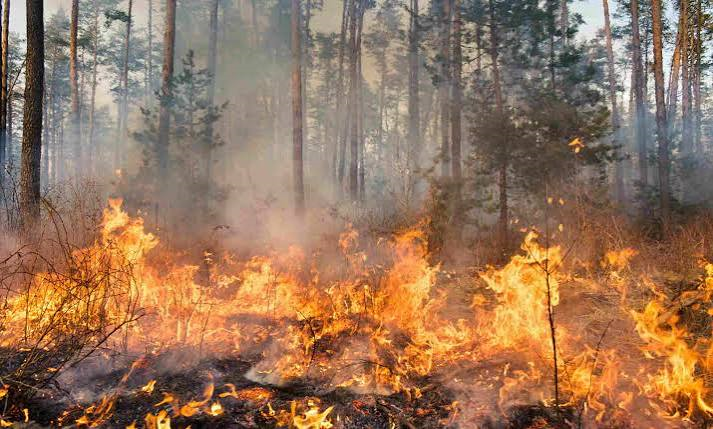
NEW DELHI: Wildfires are increasing sharply in the Eastern Ghats and showing an upward trend in parts of Central India, even as fire activity has declined in the Western Ghats, a new study tracking forest fires across 13 wildlife reserves has found.
The contrasting trends suggest that India needs region-specific fire management strategies rather than a uniform approach to protecting its forests and wildlife habitats.
The study, titled Changing Fire Regimes in Wildlife Reserves of Southern India: Trends, Drivers, and Conservation Challenges, published in the latest edition of journal Ecosphere, analysed satellite data spanning 2002 to 2022. It covered nearly 20,000 sq km across wildlife reserves in Central India, the Eastern Ghats and the Western Ghats.
Researchers found that a cumulative area of around 16,667 sq km was recorded as burned across the study landscapes during the 21-year period. The Eastern Ghats recorded the highest fire activity, accounting for 59% in the regional comparison, followed by Central India at 16.6% and the Western Ghats at 8.4%.
More concerning were the contrasting long-term trends in the annual area burned. Fire activity increased by 9.3% a year in the Eastern Ghats, a statistically significant rise. Central India recorded a marginal increase of 4.6% annually, while the Western Ghats showed a decline of 10.8% a year.
The findings suggest that wildfire risk is not uniform across India’s forest landscapes. While the Eastern Ghats are witnessing a significant increase, the decline in the Western Ghats also raises questions about the ecological consequences of reduced fire activity, particularly in habitats where fire is a natural part of ecosystem functioning.
The study was conducted by Narendran Kodandapani of the Centre for Wildlife Studies, Bengaluru, and Krithi K Karanth, also of the Centre for Wildlife Studies and the Nicholas School of the Environment, Duke University, US.
Using satellite-derived fire data from NASA’s Moderate Resolution Imaging Spectroradiometer (MODIS), the researchers examined annual burned areas, seasonal patterns and fire frequency. They found that nearly 85% of the fire activity occurred between January and March, underlining the importance of preparedness before and during the dry-season fire period.
The study also found that climate and human-related factors played a significant role in shaping fire activity, although their influence varied across individual reserves. These factors together accounted for between 21% and 77% of annual fire activity in some reserves.
Hotter and drier conditions, drought and changes in moisture levels were associated with increased fire activity in several landscapes. However, human activities also played an important role. Fires are often deliberately or accidentally started during the collection of forest produce, agricultural activities and other uses of forest resources.
Population density and forest-cover loss also showed significant relationships with fire activity in some reserves, suggesting that the interaction between human pressure, land-use changes and climatic conditions can alter the frequency and extent of fires.
The researchers pointed out that 11 of the 13 wildlife reserves showed evidence of increasing fire activity during hot and dry years. However, the relationship between climate and fires differed according to the length of the dry season, rainfall patterns, vegetation and local land-use practices.
The regional differences are particularly important for conservation. The Western Ghats, for instance, recorded an overall decline in burned area, but the researchers cautioned against assuming that fewer fires are always beneficial. Some ecosystems, including grasslands and savanna woodlands, depend on periodic fires to maintain their ecological balance.
Prolonged suppression of all fires can allow combustible material to accumulate, potentially increasing the risk of more intense fires when burning eventually occurs. Conversely, frequent or intense fires can damage vegetation, kill young trees and affect wildlife habitats.
The researchers have therefore called for a more balanced approach that recognises the ecological role of fire while preventing destructive burning. They suggest that forest management should include early-warning systems, better preparedness during high-risk periods, community participation and the use of controlled, low-intensity burning where ecologically appropriate.
The study also highlights the need to account for the dependence of forest-fringe communities on natural resources. Blanket fire suppression measures may overlook traditional practices and livelihoods, while poorly managed burning can threaten biodiversity and local communities.
The researchers said effective conservation would require forest departments and local communities to work together, taking into account differences in vegetation, climate, wildlife habitats and traditional land-use practices.