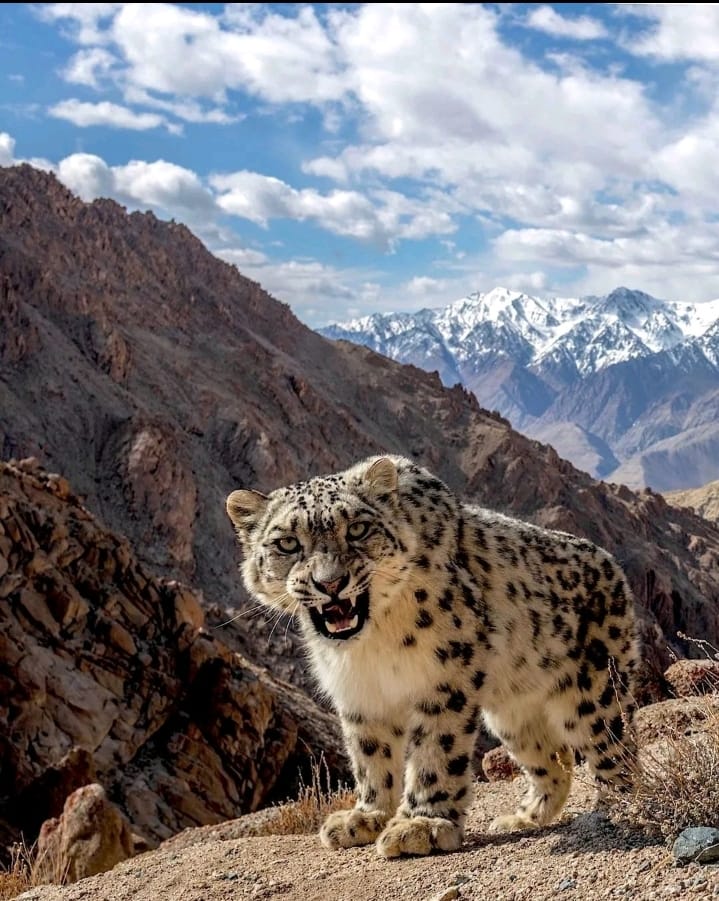
Home to a rich tapestry of life including elusive snow leopard, majestic Himalayan ibex, nimble blue sheep, and rare Himalayan wolf, Cold Desert in Himachal Pradesh’s remote Lahaul-Spiti district in the high altitude of Himalayan has earned prestigious global recognition.
Nestled in the trans-Himalayan expanse of northern India, a stark, breath-taking mosaic of glacial valleys, alpine plateaus, and rugged high-altitude deserts– the Cold Desert is now officially designated as UNESCO’s newest Biosphere Reserve.
Spanning nearly 7,770 square kilometers in Himachal Pradesh’s remote Lahaul-Spiti district, the Cold Desert Biosphere Reserve encompasses a sweeping terrain from 3,300 to 6,600 meters above sea level. It includes renowned protected areas such as Pin Valley National Park, along with the Kibber and Chandratal Wildlife Sanctuaries, forming one of the coldest and driest ecosystems within UNESCO’s global network.
Amidst this challenging environment, around 12,000 people live in scattered villages, carrying forward centuries-old traditions. They practice pastoralism, herding yaks and goats, cultivating barley and peas, and using Tibetan herbal medicine — all sustained through Buddhist monastic teachings and community councils that carefully manage these fragile alpine resources.
Unlike traditional protected areas that separate humans from nature, UNESCO Biosphere Reserves serve as “living laboratories” where conservation and human livelihoods go hand in hand. The Cold Desert perfectly embodies this philosophy, showing how resilient communities can thrive in harmony with one of the world’s most delicate ecosystems.
The reserve is home to a rich tapestry of life, including 732 species of vascular plants — among them 30 endemic to the Indian Himalayas. Hardy alpine grasses, medicinal herbs, and rare trees such as willow-leaved sea-buckthorn, Himalayan birch, and Persian juniper dot the landscape.
In a world grappling with accelerating climate change and biodiversity loss, UNESCO Biosphere Reserves offer a powerful, often overlooked solution. These sites are more than just protected lands — they are dynamic spaces where communities, scientists, and governments collaborate to build sustainable futures, said an ecologist.
With the Cold Desert’s new status, India now boasts of 13 UNESCO Biosphere Reserves, encompassing more than 10 million residents.
Globally, the World Network of Biosphere Reserves has grown to 759 sites across 136 countries, covering roughly 7.4 million square kilometers and home to approximately 275 million people. Today, 70% of UNESCO member states host at least one biosphere reserve, a testament to the world’s growing commitment to sustainable development.
This landmark designation was announced at the conclusion of the World Congress of Biosphere Reserves in Hangzhou, China, held from September 22 to 26. The Congress has set ambitious goals for the next ten years — including ensuring every UNESCO Member State has at least one biosphere reserve.