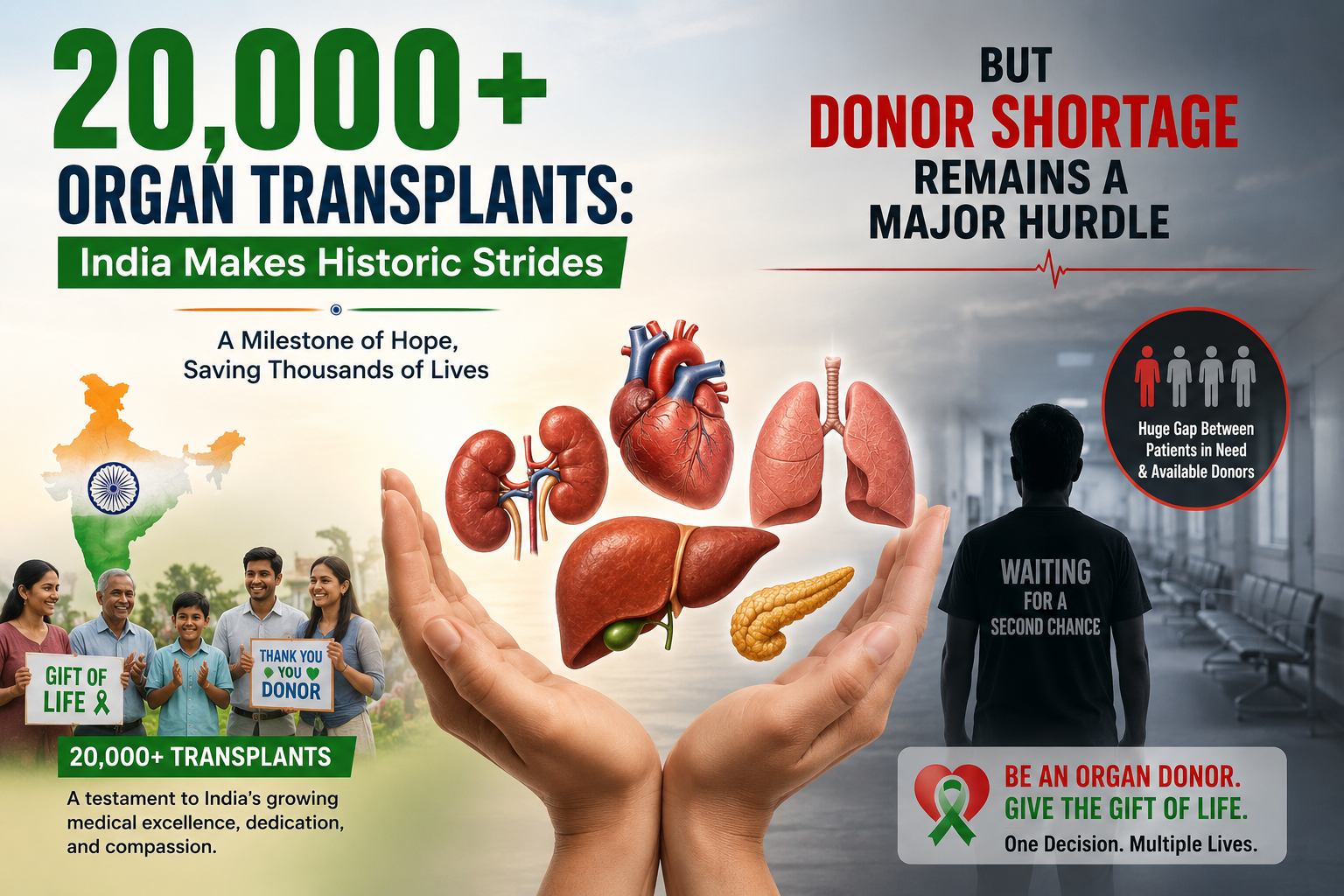
New Delhi: India has crossed a significant milestone in organ transplantation, with a record 20,138 transplants performed in 2025 — the first time the annual number has crossed the 20,000 mark.
But behind the record lies a worrying gap: the country still does not have enough donated organs to meet the needs of patients waiting for a transplant.
The 2025 figure is more than four times the 4,990 transplants recorded in 2013, reflecting the rapid expansion of transplant centres, better surgical capabilities, and improved coordination. Yet deceased organ donation remains extremely low. Official data put India’s deceased organ donation rate at less than one donor per million population, compared with about 48 per million in Spain. The mismatch is particularly stark for kidney and liver patients. More than 63,000 people are estimated to need kidney transplants and around 22,000 liver transplants, while many patients either spend years on waiting lists or never receive an organ in time.
Dr Saurabh Singhal, Senior Consultant & Director, Centre for Liver-GI Diseases and Transplantation (CLDT), Aakash Healthcare, said, “The rise from under 5,000 transplants a decade ago to over 20,000 last year shows what better infrastructure, awareness, and coordination between hospitals can achieve. However, we are still meeting only a fraction of the actual need. For every patient who receives a transplant, several more remain on the waiting list, and many will not survive the wait.”More transplants, but mostly from living donors.One of the greatest challenges is that India’s transplant growth has been driven largely by living donors, rather than deceased donors.
NOTTO’s data show that in 2023, 15,435 of the 18,378 organ transplants were from living donors, while only 2,935 were from deceased donors. This dependence puts additional pressure on families, particularly when a close relative is willing and medically suitable to donate a kidney or a part of the liver.
Dr. Rohit Kaushal, Director & Head—Urology, Robotics, Kidney Transplantation & Uro-Oncology, Asian Hospital, Faridabad, said, “What is encouraging is that this growth has not happened accidentally. It has come alongside stronger regulatory frameworks, like the new national guidelines on brain-stem death certification and swap transplantation. Standardizing these processes across states was long overdue, and it is already helping more hospitals run credible transplant programmes.”
The government has also been trying to strengthen the system. NOTTO has pushed states to improve monitoring and reporting of brainstem death and has issued directions on implementing swap transplantation. In a swap transplant, two donor-recipient pairs who are medically incompatible with their own partners can exchange donors, making transplantation possible for both patients. Doctors say the shortage is not simply a medical or infrastructure problem. Public hesitation and misinformation remain major barriers, particularly around deceased donation. Some families fear that organ donation may interfere with funeral practices or religious beliefs. Experts, however, point out that organ donation is widely supported as an act of compassion across India’s major faith traditions.
Dr. Bipin Vibhute, Consultant and Program Director, Liver Transplant & HPB Surgery, Jupiter Hospital, Pune, said, “In our experience counseling families, the hesitation comes from a lack of correct information. Every major faith practiced in India supports organ donation as an act of compassion. Once families understand that, the conversation changes completely. We need many more of these conversations happening at the community level, not just in hospitals.” Another set of myths relates to fertility, sexual health, and masculinity—concerns that doctors say can discourage both living donors and potential recipients.
Dr. Vineet Malhotra, Head of Urology, VNA Hospital, said, “Organ transplantation is not just about extending life; it is about restoring quality of life. For many male patients, a successful transplant can improve energy, hormonal health, and overall sexual function. At the same time, misconceptions that organ donation affects masculinity or reproductive health need to be actively dispelled, as they have no scientific basis.”
Dr. Vineet said, “We often see patients and families worry that donating an organ, particularly a kidney, will compromise fertility. This is not supported by evidence. A healthy donor who is properly evaluated and cleared for surgery does not face reduced fertility as a result of donation. Clearing up this specific fear can meaningfully increase the number of willing living donors.” Women, too, remain an underused potential source of living donation, experts say.
Dr. Archana Dhawan Bajaj, Founder & Director, The Nurture IVF Centre, said, “From a woman’s health standpoint, the biggest gap is simply awareness. Many women who could safely be living donors are never even approached because of assumptions about their health or family responsibilities. That needs to change, and organ donation should be discussed as openly with women as it is with men.”
Awareness must move beyond hospitals
The government has been increasing its focus on organ donation awareness. NOTTO’s website currently shows nearly 4.9 lakh donor pledges, while the Health Ministry, in July 2026, issued communications to states, union territories, and central ministries to step up awareness campaigns.
But doctors say pledging alone is not enough. A person who registers as a donor may not necessarily die in circumstances in which organs can be retrieved and transplanted. The family therefore remains crucial at the time of death. This makes it important for people not only to register their pledge but also to discuss their decision with family members, so relatives understand and respect their wishes.
Dr. Saurabh Singhal said, “We need sustained public messaging that treats organ donation as routine and not extraordinary and that directly confronts the myths, religious and otherwise, that keep families from saying yes.”