NEW DELHI: For thousands of Delhi’s schoolchildren, the day’s most dangerous part may begin on the way towards schools.
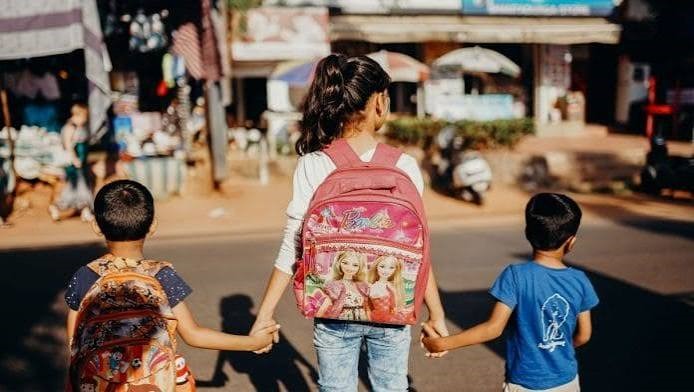
A study of 4,789 adolescents has found that nearly two-thirds cross major roads alone during their school commute. The study questions whether designers consider children when Delhi designs its roads.
The study involved students aged 10-19 in four government schools. These schools were near high-crash road stretches, or ‘black spots’. It found that walking was the most common way to reach and return from school. The daily journey often involved negotiating busy roads without adult supervision. Road crashes and speeding vehicles emerged as the biggest safety concerns.
Findings published in Injury Prevention point to a problem. It cannot be addressed simply by telling children to be more careful. Researchers said the responsibility for keeping young pedestrians safe extends to roads around schools. It also includes traffic systems and enforcement mechanisms near schools.
Walking was common among boys. 80% walked from school to home, compared with 49% of girls. Many adolescents crossed busy roads independently. Those riding to school often had to negotiate high-traffic routes alone.
The risks were not limited to traffic. Students reported fears of robbery and harassment as well. Boys were more likely to cite robbery as a concern. Girls more frequently reported fears of gendered harassment or eve-teasing.
This gender difference is significant because a “safe school route” cannot mean merely a road where vehicles move slowly. For girls in particular, safety also involves lighting, visibility, the presence of people and freedom from harassment.
“The school commute is an everyday part of adolescent life, but for many young people it also means navigating busy roads and making decisions about safety on their own. Our findings show that rather than focusing only on individual behaviour, we need to create environments that make safe travel possible,” said Pratishtha Singh, lead author of the study.
The study also exposed gaps in road-safety awareness. Nearly six in 10 students had poor knowledge of commonly encountered road signs, including signs relevant to pedestrians and school environments.
That finding raises another concern: whether conventional road-safety lessons are reaching adolescents in a way that translates into safer decisions on the street.
Researchers suggest that instead of relying only on classroom instruction, schools could use simulations, peer-led programmes and scenario-based learning to teach children how to respond to real-life traffic situations.
But education has its limits. A child may know that a zebra crossing should be used and still be forced to cross a dangerous stretch if there is no safe crossing available.
The study also found gaps in the use of basic protective measures. Among students travelling as pillion riders on motorcycles, 39% of boys and 46% of girls said they never wore a helmet. Seat-belt use among the smaller group travelling by car was also inconsistent.
The findings underline the disconnect between road-safety messaging and what adolescents actually experience during their daily travel.
The researchers argue that urban road planning needs to move beyond a predominantly motor-vehicle-centric approach. For children who walk or cycle, safety depends on whether there are continuous footpaths, protected crossings, adequate lighting and traffic-calming measures around schools.
“We cannot put the responsibility for road safety on adolescents alone. If children are walking and cycling to school, the roads and streets around them must be designed to protect them,” said Dr Jagnoor Jagnoor, senior author from The George Institute for Global Health India. He stressed the need for pedestrian pathways, better lighting, traffic calming, protected crossings and effective enforcement.
The study therefore makes a larger point about how Delhi plans its streets. When a child has to cross a major road alone simply to reach school, asking the child to “follow road-safety rules” cannot be the complete solution.
The researchers have recommended safer walking and cycling infrastructure, traffic calming around schools, stronger enforcement of helmet and seat belt rules and more engaging road-safety education. They also called for gender-sensitive safety measures and greater coordination through District Road Safety Committees and school-level Road Safety Clubs.