India generates nearly 7.8 million metric tonnes of post-consumer textile waste every year. From sarees and school uniforms to denim and household linen, fabrics form a significant part of urban waste. Yet, unlike plastic or paper, textile waste has rarely received structured attention. Most of it ends up in landfills, contributing to pollution and resource loss.
But in Navi Mumbai, a quiet shift is underway, turning this overlooked problem into an opportunity for both people and the planet.
At the centre of this transformation is a first-of-its-kind municipal Textile Recovery Facility (TRF), set up by the Navi Mumbai Municipal Corporation under the Swachh Bharat Mission–Urban 2.0. The initiative is not just about waste management — it is about rethinking how cities deal with resources, livelihoods and sustainability in a rapidly urbanising India.
The TRF functions as a circular ecosystem, integrating decentralised collection, scientific sorting, digital tracking and livelihood generation. The process begins at the community level, with specially designed textile bins placed across housing societies in all eight municipal wards. So far, about 140 bins have been installed, with plans to scale up further, making it easier for residents to participate.
Once collected, the textiles are sent to the facility in Belapur, where the real transformation begins. Unlike conventional waste sorting, this process uses technology to identify fabric types. A handheld scanner helps distinguish between cotton, polyester, wool and blended materials, allowing for precise categorisation. Each item is weighed, tagged and sorted into categories such as reusable, recyclable, upcyclable or reject.
This scientific approach ensures that nothing is wasted unnecessarily. Usable fabrics are cleaned and prepared for reuse, while others are channelled into recycling or upcycling streams. Even materials considered unusable are being experimented with — including pilot projects that convert textile waste into paper.
What makes the model stand out, however, is its human dimension. The initiative has brought hundreds of women, many of them homemakers, into the formal economy. Through structured training programmes, they learn skills such as fabric identification, repair techniques and product design. Today, over 150 women are actively engaged in the process, earning a steady monthly income.
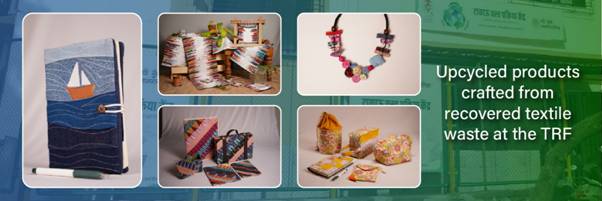
Inside the facility, discarded clothes are given a second life as bags, mats, garments and home décor items. These products are then showcased at exhibitions and public events, where they find buyers who are increasingly conscious about sustainable consumption. For many of these women, the work is not just about income — it is about dignity, skill and participation in a larger environmental mission.
The scale of impact is already visible. The initiative has collected around 30 metric tonnes of textile waste, processing tens of thousands of individual items. Outreach efforts have reached over one lakh families, encouraging citizens to rethink how they dispose of clothing. Workshops and awareness campaigns have helped bridge the gap between intention and action.
Like any new system, the project faced initial teething problems. Resistance to placing bins, limited awareness about textile segregation and the complexity of handling mixed fabrics posed hurdles. But a phased rollout, combined with continuous engagement and the use of technology, has helped overcome these barriers.
The next phase of the project aims to expand capacity with a permanent, larger facility in Koparkhairane near Nisarg Udyan. This signals that the model is here to stay. More importantly, it offers a template for other cities grappling with similar challenges.
As India looks to strengthen its urban systems, initiatives like this highlight the potential of combining policy, technology and community participation. The Textile Recovery Facility aligns with broader national goals — from cleaner cities to sustainable consumption — while also addressing local realities. No doubt, the city is not just managing waste — it is redefining value.
#waste #mumbai #impact #nisargudyan #textile #wastetoworth #wastemanagement
For further queries contact indiahealthbuddy@gmail.com