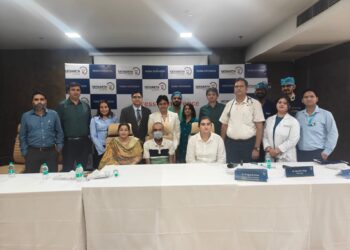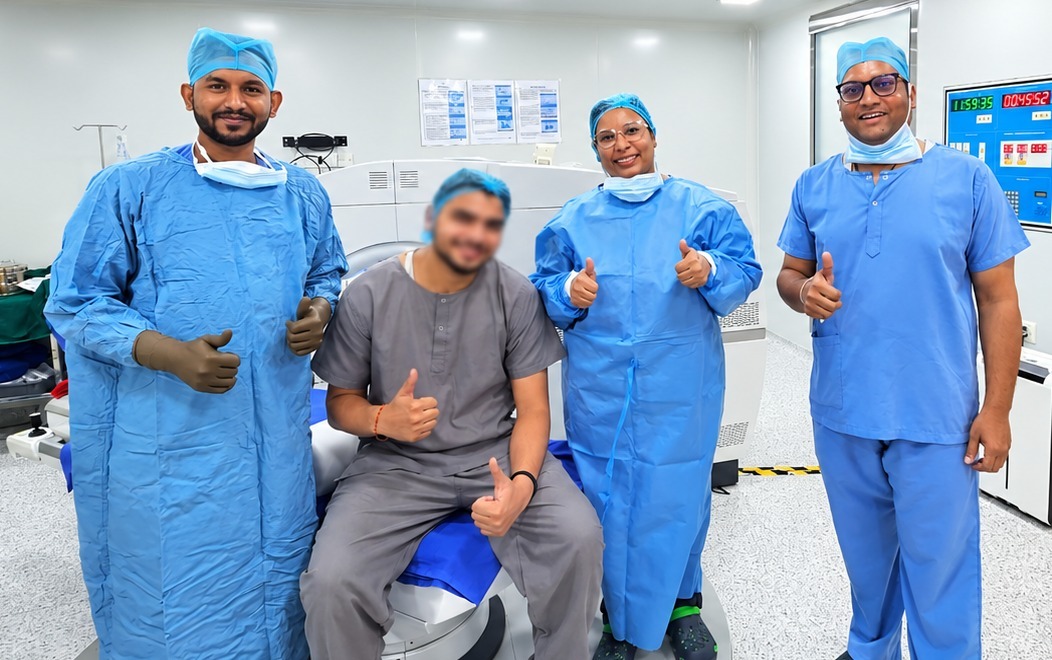
NEW DELHI: For 22-year-old IT professional Varun Dagar, a corneal procedure has brought a sharp improvement in vision after advanced keratoconus began making even routine tasks such as reading and working on a computer increasingly difficult.
Varun, from Noida, underwent Corneal Allogenic Intrastromal Ring Segments (CAIRS) along with Corneal Collagen Cross-Linking (C3R) on his left eye at Dr Agarwals Eye Hospital, Preet Vihar here.
His unaided vision in the affected eye had fallen to 3/60 before surgery and improved to 6/24 the next day. With a pinhole, it reached 6/9, according to the treating team.
Keratoconus is a progressive condition in which the cornea, the transparent front surface of the eye, becomes thin and develops an irregular, cone-like shape. This can cause blurred and distorted vision, glare and increasing difficulty in correcting sight with conventional glasses.
For Varun, the problem had been worsening for years. He needed frequent changes in his glasses and increasingly struggled to work on a computer, read and recognise faces from a distance. He was initially diagnosed with keratoconus by an ophthalmologist in Haryana and was later referred to Delhi for specialised treatment.
At Dr Agarwals Eye Hospital, he was evaluated by Dr Saumya Sharma, senior ophthalmologist, who recommended CAIRS with C3R for his advanced disease.
“Keratoconus in a young patient like Varun needs to be addressed promptly, as the cornea can continue to weaken and vision can deteriorate over time. In advanced cases like his, we may recommend CAIRS along with C3R,” Dr Sharma said.
CAIRS involves placing small segments made from donor corneal tissue inside the cornea. These segments help alter the irregular shape of the cornea and improve the way light is focused. C3R, or corneal collagen cross-linking, is used to strengthen the cornea and help slow further progression of keratoconus.
“In Varun’s case, we saw a significant improvement within 24 hours. His unaided vision improved from 3/60 before surgery to 6/24 the next day and reached 6/9 with a pinhole,” Dr Sharma said.
The surgery took about 60 minutes. It involves creating a precise channel within the cornea using a femtosecond laser and then carefully inserting the donor corneal segment. The technique requires specialised training and surgical precision.
For a young working professional, the improvement had an immediate practical impact. Varun was able to see more clearly for computer work, reading and recognising faces and returned to his office within a week.
“I had been struggling with my vision for a long time and kept changing my glasses, but nothing seemed to help. I was nervous when I first heard about the surgery, but Dr Sharma explained everything to me clearly and made me feel comfortable,” Varun said.
“The morning after the surgery, I can see much better now than I could before my surgery, and I honestly couldn’t believe it. I’m thankful to the doctors,” he said.
Doctors said keratoconus often develops in adolescence or young adulthood, making early detection important. The condition can run in families and has also been associated with frequent or vigorous eye rubbing, particularly among people with allergic eye disease.
Dr Soosan Jacob, director and chief, Refractive and Cornea Foundation, Dr Agarwals Eye Hospital, said CAIRS provides an option for some patients with advanced keratoconus while preserving their own cornea.
“CAIRS is one of the most valuable additions to our surgical armamentarium for keratoconus, offering patients like Varun a way to regain functional vision while preserving their own cornea rather than requiring a transplant,” she said.
She said increasing diagnosis of keratoconus among young adults made early detection and timely access to specialised treatment important.
The procedure is among the surgical innovations associated with Dr Amar Agarwal, chairman, Dr Agarwals Eye Hospital.
Varun has been advised postoperative eye drops for three months and regular follow-up during the healing period. While the early improvement has been encouraging, longer-term monitoring remains important because keratoconus is a progressive condition.