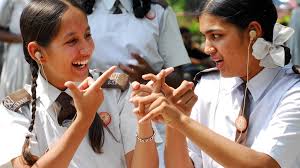
Citing a government survey that around one in five (over 19%) of India’s deaf and hard-of-hearing children were out-of-school in 2014, a new study has called upon the Government to address the ongoing educational crisis by recognising Indian Sign Language as an official language; rejecting ‘oralism’, the belief that deaf people can and should communicate exclusively by lipreading and speech; and opening more schools and higher education institutes for deaf and hard-of-hearing (DHH) students.
“Many thousands of children who are deaf or hard-of-hearing are missing out on school in India,” said Dr Abhimanyu Sharma, from Cambridge’s Faculty of Modern & Medieval Languages & Linguistics, the study’s author. “This has a huge impact on their wellbeing and life chances.”
“One of the main reasons for this very high dropout rate is that their schools do not offer education in sign language.”
Dr Sharma’s study, published in Language Policy, explains that sign language continues to be ‘shunned’ in most Indian schools because it is still stigmatised as a visible marker of deafness. But, he argues, the alternative preferred by many schools, ‘oralism’ harms the school attainment of deaf students.
“Outside of India, ‘oralism’ is widely criticised but the majority of schools in India continue to use it,” Dr Sharma says. “Gesturing is not sign language, sign language is a language in its own right and these children need it.”
“When I was in primary school in Patna, one of my fellow students was deaf. Sign language was not taught in our school and it was very difficult for him. I would like to support the charities, teachers and policymakers in India who are working hard to improve education for such students today.”
Dr Sharma acknowledges that the Indian Government has taken important steps to make education more inclusive and welcomes measures such as the establishment of the Indian Sign Language Research and Training Centre in 2015. But, he argues, far more work is needed to ensure that DHH students receive the education which they need and to which they are legally entitled.
Sharma calls for constitutional recognition for Indian Sign Language (ISL) as well as recognition of ISL users as a linguistic minority. Being added to India’s de facto list of official languages would direct more Government financial support to Indian Sign Language.
“Central and state governments need to open more schools and higher education institutes for deaf and hard-of-hearing students,” Sharma also argues.
“In the whole of India, there are only 387 schools for deaf and hard-of-hearing children. The Government urgently needs to open many more specialist schools to support the actual number of deaf and hard-of-hearing children, which has been underestimated.”
He points out that deaf and hard-of-hearing people were undercounted in India’s last census because of the use of problematic terminology. The 2011 census reported around 5 million deaf and hard-of-hearing people in the country but in 2016, the National Association of the Deaf estimated that the true figure was closer to 18 million people.
Sharma also highlights the need for more higher education institutions for these students as there are very few special colleges for them, such as the St. Louis Institute for Deaf and Blind (Chennai, Tamil Nadu). He also calls for an increase in the number of interpreter training programs available across Indian universities.
Dr Sharma advises central and state governments to conduct regular impact assessments of new policy measures to ensure that they are improving inclusion for deaf and hard-of-hearing people.
He also calls on the government to invest in research to support more targeted approaches to teaching and learning for DHH students, and to support public awareness campaigns to tackle biases and negative social attitudes towards deafness.
Dr Sharma’s study examines developments in Indian legislation and policy relating to DHH people since the 1950s. He highlights the fact that parliamentary debates in the Upper House about DHH people declined from 17 in the 1950s, to just 7 in the 1990s, before rising to 96 in the 2010s.
India’s language policy requires pupils to learn three languages at the secondary stage of schooling. Given the problematic nature of the three-language formula for deaf students, the 1995 Persons with Disabilities Act rescinds this requirement for these learners and decrees that they should learn only one language.
The drawback of the 1995 Act, however, is that it does not mention the use of sign language and does not specify how language learning for such learners will be realised. Dr Sharma recognises that the Rights of Persons with Disabilities Act 2016 brought significant improvements but highlights the gap between decrees and implementation. The 2016 Act decrees that the Government and local authorities shall take measures to train and employ teachers who are qualified in sign language and to promote the use of sign language.
“In practice, India does not have enough teachers trained to support deaf and hard-of-hearing students, but I am positive that the country can achieve this,” Dr Sharma said.
(University of Cambridge media release)