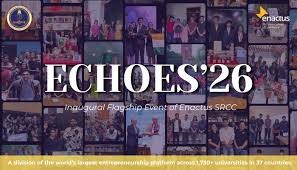
New Delhi: On a winter afternoon of February 26, 2026 softened by warm sunlight, the corridors of Shri Ram College of Commerce, Delhi University here carried an unusual sense of purpose. Footprints painted along the pavement — some small, some uneven — led visitors through spaces reimagined for accessibility, marking the beginning of ECHOES, an initiative that sought to place inclusion at the centre of campus life.
Organised by Enactus SRCC, the event stood out not merely for its scale, but for its intent. Designed and executed by first-year students, it attempted to bridge the often invisible distance between intention and lived reality for persons with disabilities.
“This is a one-in-a-million initiative. I am so pleased to see such young, first-year students working on something as unique as inclusivity and proactively striving towards a social cause. Seeing people singing the national anthem in sign language showed me that empowerment starts with an accepting platform,” recalled a representative from Action for Autism, reflecting on the day’s proceedings.
At its heart, ECHOES was not about spectacle but about voice. The day began with an art competition for specially-abled children, where sheets of paper slowly filled with drawings of homes, vehicles and everyday scenes. Yet, beyond these simple images lay narratives of identity, aspiration and resilience. In each stroke of colour, participants expressed not just creativity but presence — a quiet assertion that their stories, too, deserve space and acknowledgement.
The programme unfolded through a series of speeches and testimonials that moved between personal struggle and collective hope. Speakers spoke candidly of physical challenges and the emotional weight of questions such as “why me?”, while also recounting their journeys towards self-acceptance and societal recognition. What emerged was a shared insistence on shifting perceptions — from being seen as a burden to being acknowledged as contributors and achievers.
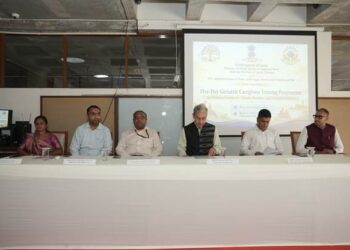
A panel discussion brought into focus the structural barriers that continue to limit inclusion. Participants pointed to gaps in physical infrastructure, noting that inaccessible buildings and public spaces often exclude individuals before conversations can even begin. The role of technology, too, was highlighted — not as a luxury, but as a necessary tool to widen access. Inclusion, the panel emphasised, must be internalised as a norm rather than extended as a privilege.
Questions around policy support, particularly in the context of para-sports, also found space in the discussion. Panelists underlined the need for sustained opportunities and institutional backing to ensure that differently-abled individuals can pursue excellence in sports and beyond.
One of the most striking moments of the day came with the launch of an adaptive apparel line under Project Aavaran. The runway, often associated with exclusivity, was transformed into a space of representation. Differently-abled models walked with confidence, wearing garments thoughtfully designed for comfort and ease — magnetic buttons replacing traditional fastenings, elasticated backs, pull-up tabs, and zip-openable hems that addressed practical challenges of daily wear. The applause that followed was not just for the designs, but for the visibility they offered.
Cultural performances added another dimension to the event. Students from partner organisations took to the stage with dance and theatre, using movement and expression to tell stories of resilience. A video message by Dr. Mahantesh, President of the Cricket Association for the Blind, underscored a significant shift — that with acceptance and opportunity, differently-abled individuals increasingly see themselves not through the lens of limitation, but as “champions”.
Importantly, the organisers ensured that inclusion extended beyond messaging to practice. The campus spaces were made accessible, and Indian Sign Language interpreters were present throughout, enabling fuller participation.
The event concluded with a musical performance that gradually turned into a collective celebration, as specially-abled students joined in, their voices blending with those on stage. It was a moment that captured the spirit of the day — not of difference, but of shared experience.
ECHOES is an inclusive social impact event celebrating the abilities and creativity of differently abled individuals and promotes adaptive and accessible design in everyday clothing and footwear. The event brings together para-athletes, persons with disabilities, students, designers, NGOs, and policymakers to foster inclusion and dialogue.
#shriramcollegeofcommerce #delhiuniversity #autism #echoes #enactussrcc #indiansignlanguage
For any query, contact indiahealthbuddy@gmail.com