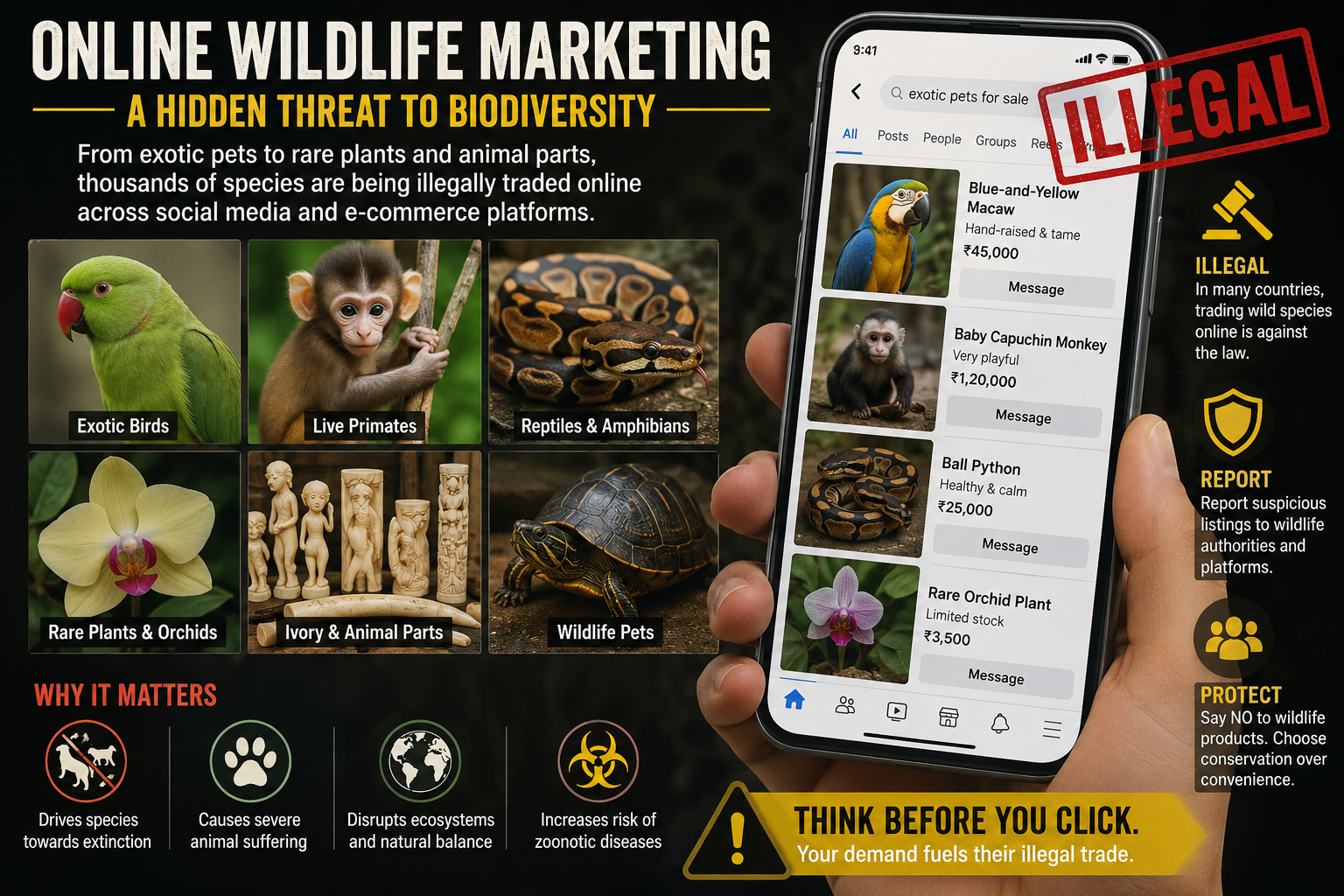
New Delhi: A wildlife trafficking problem that once depended largely on forests, border routes and physical markets is increasingly moving to a place most people use every day — the internet.
A new review by an international team of researchers has warned that online platforms are rapidly becoming marketplaces for illegally traded wildlife, exposing thousands of animals, plants and fungal species to exploitation while making trafficking faster, wider and harder to detect.
The study, published in Nature Reviews Biodiversity, found that species ranging from primates, birds, reptiles and amphibians to orchids and other plants are being offered through online platforms.
Many of the species being traded are already threatened with extinction, while some had not previously been recognised as being at significant risk from illegal wildlife trade.
The scale of the problem was underlined by monitoring conducted over six weeks in mid-2025, which identified more than 1,600 primates advertised for sale across Facebook, Instagram, TikTok and YouTube.
Researchers said the figures should not be interpreted as representing the entire online wildlife trade. Rather, they provide a snapshot of how rapidly digital platforms are changing the scale and nature of wildlife trafficking.
Traditionally, illegal wildlife trade involved physical networks of hunters, middlemen, traders and buyers. Online platforms have changed that equation.
A seller can now reach potential buyers across cities and countries without maintaining a conventional shop or openly displaying the animals. Advertisements can be posted, removed and reposted rapidly, while communication and transactions can shift between platforms.
“The online illegal wildlife trade spreads across many platforms, including popular social media platforms, and represents a growing and evolving threat to biodiversity conservation,” said Professor Enrico Di Minin of the University of Helsinki, who led the review.
For traffickers, researchers said, the attraction is obvious: online platforms provide speed, scale, anonymity and access to a global consumer base.
For wildlife, however, the consequences can be devastating.
Animals may be removed from the wild to satisfy demand for exotic pets, ornaments, traditional products or collectors’ markets. The removal of individual animals can have consequences beyond the animal itself, particularly when rare species are targeted.
The researchers warned that online wildlife trafficking is not simply an animal-welfare issue. It can undermine entire ecosystems by removing species from already fragile populations.
Species with small populations are particularly vulnerable. When demand increases, collectors and traffickers can target increasingly rare animals and plants because their scarcity itself can make them more valuable.
“The negative impacts on animal welfare and biodiversity mirror those of traditional offline illegal wildlife trade, but the reach and speed of online platforms are magnifying these harms,” said Dr Neil D’Cruze of Manchester Metropolitan University, a co-author of the review.
The problem can also extend across borders. Online networks allow sellers, intermediaries and buyers to operate in different countries, making enforcement more complicated and creating jurisdictional challenges for authorities.
Researchers said some digital networks may supplement traditional trafficking routes, while others could increasingly replace them.
The warning has particular relevance for India, one of the world’s biodiversity-rich countries and home to thousands of species, many of which face pressure from habitat loss, illegal hunting and trade.
India’s wildlife protection framework prohibits or regulates trade in protected wildlife and their derivatives, but the migration of illegal trade to digital platforms creates a new enforcement challenge.
Social media posts offering exotic birds, reptiles, turtles, mammals or rare plants may not always look like conventional wildlife-trafficking advertisements. Some may be disguised as legitimate pet sales, private collections or informal exchanges.
The digital nature of such transactions also means that a buyer need not be physically close to the animal or plant being sold.
This makes online surveillance, platform accountability and coordination between wildlife authorities, police, customs agencies and technology companies increasingly important.
There is another dimension that should not be overlooked.
Moving wild animals across borders and keeping stressed, illegally captured animals in unsuitable conditions can increase opportunities for pathogens to cross between wildlife, humans and domestic animals.
The researchers therefore link online wildlife trafficking not only to biodiversity and animal welfare but also to public-health concerns.
This does not mean every wildlife transaction poses a disease threat. But illegal capture, transport and close confinement of wild animals can create conditions in which infections may spread.
The review identifies perceived low risk, weak regulatory governance and the anonymity offered by online platforms as important factors allowing the trade to flourish.
But enforcement alone may not be enough.
Demand remains a crucial part of the equation. As long as consumers are willing to pay for rare animals, exotic pets, unusual plants or wildlife-derived products, traffickers have an incentive to find new species and new ways of reaching buyers.
Dr Annette Hübschle of the University of Cape Town, another co-author, said tackling the problem would require stronger species protection alongside greater regulatory and technological capacity and meaningful involvement of local communities.
Researchers are calling for a coordinated response involving governments, conservation agencies, technology companies, researchers, local communities and consumers.
Platforms could strengthen systems for identifying suspicious wildlife advertisements, improve mechanisms for reporting illegal listings and share relevant information with enforcement agencies, subject to applicable laws and safeguards.
Authorities, meanwhile, need better data on what is being sold, who is buying it, where the trade originates and how digital networks operate.
The study also highlights gaps in existing knowledge. Researchers said the full scale of online wildlife trafficking remains difficult to measure because advertisements can disappear quickly and trade can move between platforms.
As Professor Di Minin put it, tackling online wildlife trafficking is difficult but not impossible. It will require policies that recognise that wildlife trafficking is no longer confined to physical markets.