NEW DELHI: Emphasising the enduring importance of clinical skills in medical practice, Union Minister Dr. Jitendra Singh on Tuesday called for a robust clinical foundation in medical education, even as Artificial Intelligence (AI) continues to reshape healthcare delivery and research.
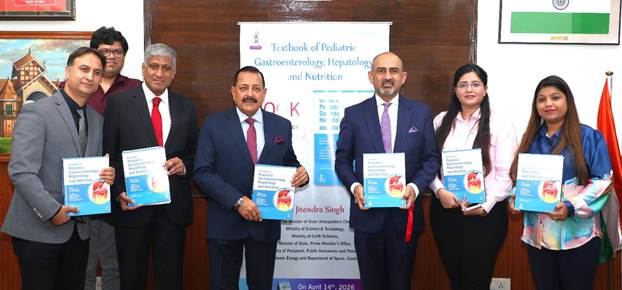
The Minister, who is also a Professor of Medicine and Diabetes, was speaking at the release of the second edition of the postgraduate textbook Pediatric Gastroenterology, Hepatology and Nutrition, edited by Prof. Anupam Sibal and Dr. Sarath Gopalan. The book carries a foreword by Prof. Kathleen B Schwartz of the Johns Hopkins University School of Medicine.
Highlighting the evolving interface between technology and medicine, Dr. Singh said that while AI has the potential to significantly enhance medical practice, it must remain a supportive tool rather than a substitute for foundational clinical knowledge.
“Once a sound clinical foundation is established, Artificial Intelligence can serve as a valuable enabler, assistant and facilitator,” he said. “However, if one turns to AI before grasping the essence of medical concepts, there is a risk of missing the basic learning process essential for becoming a competent clinician, who could be capable of serving the society even in the absence of any instruments, gadgets, investigations or even drugs.”
He underlined that the essence of medical training lies in developing the ability to diagnose and manage patients through clinical acumen, particularly in resource-constrained settings where access to advanced technologies may be limited.
Referring to the rapid expansion of medical knowledge, Dr. Singh observed that the pace of research and scientific publication has grown exponentially in recent years. This, he said, makes it imperative for medical education to remain anchored in conceptual clarity and hands-on clinical training.
“While new technologies have made access to information easier, the process of learning must continue to be rooted in fundamental understanding and practical exposure,” he noted.
The Minister also stressed the need to periodically update medical curricula to keep pace with emerging healthcare challenges, including the increasing complexity of diseases and the integration of digital technologies into clinical practice. He said young doctors must be encouraged to build strong basics before moving towards specialisation in their chosen fields.
The newly released second edition of the textbook reflects these changing dynamics. Expanded to 45 chapters, it incorporates recent advances in pediatric gastroenterology, hepatology and nutrition, and introduces several new and emerging areas of study.
The book provides detailed coverage of key clinical conditions such as inflammatory bowel disease, neuro-gastroenterology, celiac disease and cow’s milk protein allergy. It also addresses emerging domains including the role of genetics in gastrointestinal and liver disorders, advances in endoscopy techniques and developments in liver transplantation.
Experts at the event pointed out that gastrointestinal and liver-related disorders constitute a significant burden in pediatric practice. It was noted that nearly 30% of children visiting pediatricians present with such conditions, underscoring the need for specialised training and updated clinical knowledge in this field.
Designed as a comprehensive resource, the textbook aims to serve postgraduate trainees, specialists in pediatric gastroenterology and practicing pediatricians. It seeks to bridge the gap between evolving scientific research and day-to-day clinical practice.
The publication has been jointly edited by Prof. Sibal, who serves as Group Medical Director and Senior Pediatric Gastroenterologist and Hepatologist at the Apollo Hospitals, and Dr. Gopalan, Consultant Pediatric Gastroenterologist and Hepatologist at Madhukar Rainbow Children’s Hospital. Dr. Mohammad Ishaq Malik, Associate Professor at Government Medical College, Srinagar, is the co-editor.
The foreword by Prof. Schwartz highlights the growing global relevance of pediatric gastroenterology and the need for collaborative knowledge-sharing across borders. The first edition of the textbook, released in 2016, had set a benchmark in the field and was launched by the then Union Health Minister.
Building on that foundation, the latest edition incorporates contemporary scientific developments, clinical practices and evolving treatment approaches, reflecting the dynamic nature of the specialty.
He concluded by urging medical educators and institutions to strike a balance between embracing technological advancements and preserving the core principles of clinical medicine — a balance that, he said, will define the future of healthcare delivery in the country.