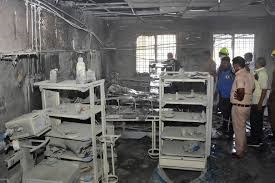
NEW DELHI: In the wake of repeated fire tragedies in hospitals across India, the Centre has rolled out a revised set of fire and life safety guidelines for healthcare facilities, introducing stricter norms on emergency preparedness, evacuation systems, electrical safety and accountability mechanisms.
According to Union Health Ministry officials, hospitals pose unique fire management challenges because they function in oxygen-rich environments and operate heavy electrical equipment round the clock. Unlike commercial buildings, evacuation during a hospital fire is far more complicated due to the presence of patients on ventilators, newborns, elderly people and those dependent on life-support systems.
A senior Health Ministry official said, “the updated 2026 guidelines, issued by the Ministry of Health and Family Welfare, replace the earlier 2020 framework and are aimed at strengthening fire prevention measures in both government and private hospitals.”
One of the key changes introduced in the new guidelines is a risk-based safety model. Hospitals will now be required to identify high-risk zones within their premises — including ICUs, operation theatres, neonatal intensive care units (NICUs), oxygen storage sections, electrical rooms and medical gas pipeline areas — and implement targeted monitoring and safety measures in these spaces.
The revised document also places strong emphasis on infrastructure preparedness. Detailed protocols have been laid down for fire alarms, smoke detection systems, fire suppression arrangements, electrical wiring, ventilation systems, heating and cooling infrastructure, and the safe handling of medical gases.
The official said, “lectrical overload and faulty wiring continue to be among the leading causes of hospital fires in India.”
Another major focus area is evacuation planning. Since critically ill patients cannot always be moved quickly outdoors, hospitals have been advised to adopt phased and horizontal evacuation strategies instead of relying solely on mass evacuation methods.
Under the revised norms, staff must be trained to shift patients safely from one fire-safe compartment to another inside the building before considering external evacuation.
This becomes particularly important in ICUs, NICUs, paediatric intensive care units (PICUs) and operation theatres, where moving patients abruptly may itself become life-threatening.
The guidelines also seek to fix a longstanding problem seen during hospital fire incidents — confusion over responsibility and delayed response.
Hospitals will now be expected to establish clearer governance structures, including dedicated fire safety committees, designated fire safety officers and defined emergency roles for healthcare workers and administrators.
Regular fire drills, safety audits and staff training programmes have also been made a central part of the revised framework.
Experts said that during several previous incidents, lack of preparedness among hospital staff worsened the situation, with many employees unsure about evacuation routes, emergency protocols or the use of firefighting equipment.
The guidelines have been aligned with the provisions of the Bureau of Indian Standards’ National Building Code 2016 and will function alongside the updated National Building Construction Standards 2026 and state-specific fire safety laws.
The document was prepared after consultations with multiple technical agencies, including the Directorate General Fire Services, Civil Defence and Home Guards, AIIMS institutions, the School of Planning and Architecture, and fire safety experts, said the official.
He said, the larger goal is to create a stronger “safety culture” within hospitals through continuous monitoring, routine compliance audits and greater awareness among healthcare workers.
“In many cities, inspections carried out by civic bodies have uncovered serious violations ranging from blocked emergency exits and non-functional fire alarms to overcrowded ICUs, poor electrical maintenance and expired fire no-objection certificates (NOCs).”
Several hospitals were also found to have skipped mandatory fire drills.
Some of the country’s worst hospital fire tragedies have highlighted these vulnerabilities. For instance, in 2016, at least 22 people died after a fire broke out in the ICU of a private hospital in Bhubaneswar. Investigations later revealed alleged lapses in mandatory fire safety clearances.
More recently, a fire at SCB Medical College and Hospital in Cuttack reportedly claimed the lives of 12 of the 23 ICU patients admitted to the trauma care unit.
Last year, six patients died in an ICU fire in Rajasthan, while another tragedy in Jhansi led to the deaths of newborns in a neonatal ICU fire. Maharashtra too reported multiple hospital fire incidents in recent years.
An audit conducted after the Jhansi incident reportedly found exposed wiring, poor earthing systems and overloaded electrical circuits — all recognised as major contributors to electrical fires in hospitals.
#fire #revisedguidelines #unionhealthministry #safety #hospitals #public #private
For any query, contact indiahealthbuddy@gmail.com