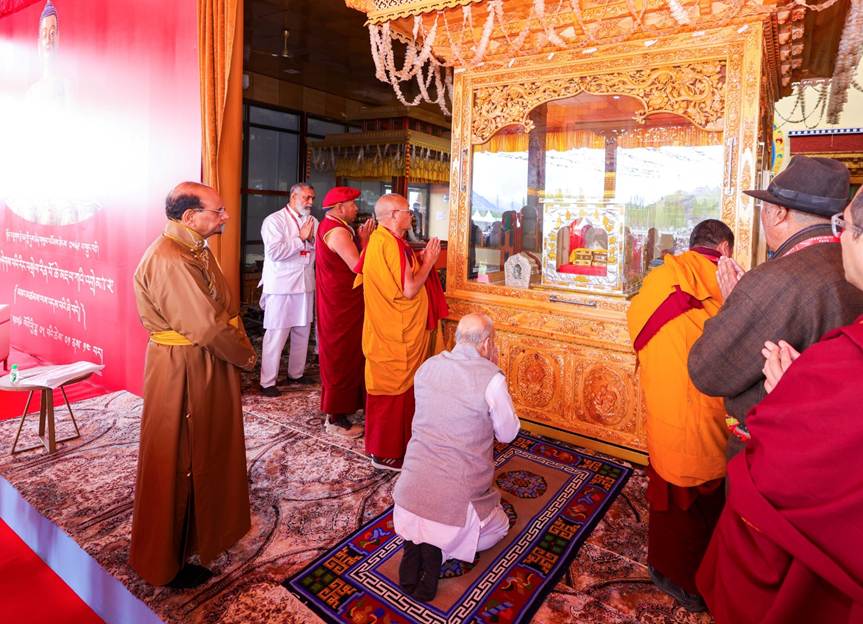
NEW DELHI: Calling it a “historic and golden moment” for Ladakh, Union Home Minister Amit Shah recently inaugurated the exposition of the sacred relics of Gautama Buddha in Leh, saying their return to the Himalayan region after 75 years was not merely a religious occasion but a civilisational reunion rooted in peace, compassion and cultural heritage.
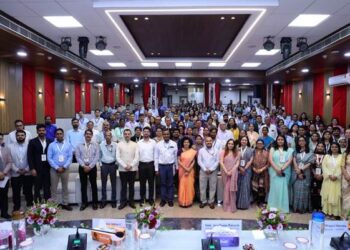
The ceremony, held on the occasion of Buddha Purnima, was attended by Lieutenant Governor of Ladakh V.K. Saxena, senior officials and Buddhist community leaders.
Addressing the gathering, Shah said the arrival of the sacred relics on Buddha Purnima carried deep spiritual significance. “It is rare that the birth, enlightenment and Mahaparinirvana of Lord Buddha are all commemorated on the same day. This makes today extremely sacred and inspiring,” he said.
Describing Ladakh as a centuries-old “living land of Dhamma”, the Home Minister said the region had played a crucial role in preserving Buddhist teachings during periods of turmoil and later spreading them across Asia. “After so many years, Tathagata Buddha has returned to this sacred land, his most beloved land. This is a matter of immense fortune,” he said.
Shah noted that Ladakh had historically served as a bridge for the spread of Buddhism from India to countries such as China and Tibet through ancient trade and cultural routes. He said the region’s spiritual identity had evolved through the influence of four major Buddhist traditions — Nyingma, Kagyu, Sakya and Gelug.
Highlighting the philosophical relevance of Buddhism in contemporary times, he said the teachings emerging from Ladakh continue to offer guidance to the world. “The message of truthfulness, self-reflection, discipline and harmony between knowledge and practice is more relevant today than ever before,” he said.
The Home Minister also stressed that India’s civilisational heritage had always promoted coexistence and peace. “In regions marked by diversity such as Ladakh and Kargil, the message of compassion and harmony becomes even more important,” he said, adding that the world today needed to embrace the middle path shown by Lord Buddha.
Tracing the historical evolution of Buddhism in Ladakh, Shah said the region first came under Buddhist influence during the reign of Ashoka, whose envoys helped lay the foundations of Buddhist philosophy in the Himalayan belt. During the Kushan period between the first and third centuries, Mahayana Buddhism flourished in the region, evidence of which still survives in ancient stupas, inscriptions and Buddhist artefacts.
He added that the Silk Route later transformed Ladakh into an important centre not only for trade but also for intellectual and spiritual exchange connecting Kashmir, Tibet, Yarkand and Khotan. Between the seventh and tenth centuries, Mahayana and Vajrayana traditions entered Ladakh through Tibet, enriching the local Buddhist culture further.
Shah also referred to the translation of Sanskrit texts into Tibetan during the 10th and 11th centuries and the establishment of 108 monasteries, including the famed Alchi Monastery, which helped institutionalise Buddhism in the region.
“Even today, Buddhist traditions across the world consider the knowledge preserved and enriched in Ladakh to be of immense importance,” he said. Citing Mahayana literature, he added that viewing the sacred relics was considered equivalent to having the darshan of Lord Buddha himself.
The Home Minister urged the Ladakh administration to make adequate arrangements for devotees and visitors from across the country and abroad to view the relics. He said the teachings of Lord Buddha, delivered more than 2,500 years ago, remain deeply relevant in a world grappling with conflict and unrest.
“The world must understand and accept India’s message of peace and the teachings of Lord Buddha, and move forward on the path of balance and solutions,” Shah said.
#amitshah #ladakh #leh #buddhist #traditions #world #mahayana #literature #peace
For any query, contact indiahealthbuddy@gmail.com