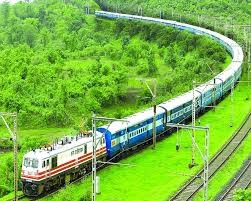
NEW DELHI: In a significant push towards modernising railway infrastructure and improving passenger safety, the Union Ministry of Railways has decided to introduce composite sleepers in critical sections of the track network, alongside deploying Artificial Intelligence (AI)-based monitoring systems.
The decisions were taken at a high-level review meeting held at Rail Bhavan recently, chaired by Union Railway Minister Ashwani Vaishnaw, where officials assessed ongoing safety and infrastructure measures.
As part of the new initiative, conventional iron and concrete sleepers used in bridge approaches as well as at points and crossings will be gradually replaced with advanced composite sleepers. Officials said the move is expected to improve both operational efficiency and passenger comfort, particularly in sensitive track segments.
Composite sleepers, made from a mix of engineered materials, are significantly lighter than traditional alternatives while offering higher load-bearing capacity. According to officials, these sleepers can withstand loads of up to 700 kg per square centimetre, making them suitable for high-stress sections of railway tracks.
“The new sleepers offer better cushioning and are easier to install and maintain. Their design can also be customised based on site-specific requirements,” a senior official said, adding that this flexibility would be particularly useful in bridge zones and complex track layouts.
Railway authorities believe that the improved shock absorption provided by composite sleepers will result in smoother rides for passengers, especially when trains pass over bridges or navigate crossings. In addition, their longer lifespan is expected to reduce the frequency and cost of maintenance, thereby improving overall system efficiency.
In a parallel move to strengthen track safety, the Railways has also decided to adopt AI-based monitoring of tracks. Under this system, inspection vehicles will be equipped with specialised devices capable of assessing the condition of the track foundation in real time.
The technology, based on Ground Penetration Radar (GPR), will enable engineers to detect subsurface defects and structural weaknesses that are not visible during routine inspections. Officials said this would allow for early identification of potential risks, helping prevent accidents and ensuring timely maintenance interventions.
“AI-enabled systems will enhance the precision and speed of track inspection. It marks a shift from reactive maintenance to predictive monitoring,” the official noted.
Further, in an effort to improve the quality and reliability of welded rail joints, the Railways has decided to introduce Magnetic Particle Testing. This advanced technique is capable of detecting minute cracks and defects in welds that may otherwise go unnoticed, thereby strengthening track integrity.
The combined adoption of composite materials and advanced diagnostic technologies reflects Indian Railways’ increasing focus on leveraging innovation to address long-standing challenges in infrastructure and safety.
Officials emphasised that these measures are part of a broader strategy to modernise the railway network while prioritising passenger safety and comfort. With one of the largest rail networks in the world, the timely upgradation of track components and monitoring systems remains critical.
#railways #sleepers #articficalintellegence #railnetworks #railwaysministry #ashwanivaishnaw
For further queries, kindly contact indiahealthbuddy@gmail.com